Pergolenviertel: from Kleingärten to a neighbourhood
Hamburg needs more homes where people actually want to live, and Pergolenviertel shows one way to build them.

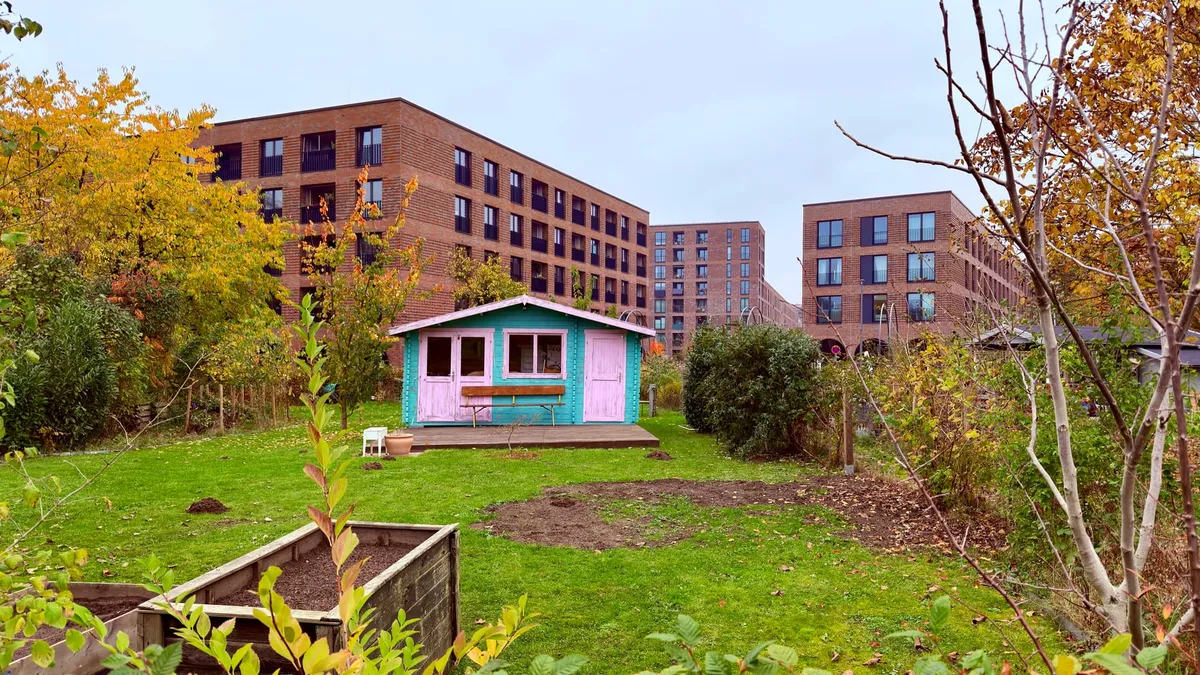
If you ask anyone on the street what the biggest problem in Hamburg is, you will probably hear the same answer: housing.
When I moved to Hamburg in 2018, it took me around three months to find a flat, and it was a big hassle. Every day after work, I went to a viewing, alone or with a colleague, since I didn't speak any German at that time. It was always the same: a long line stretching down the street, a quick look at the flat, and a sheet of paper with my details for the landlord. Usually, there was complete silence.
From what I hear, it has only got worse since then, and prices have skyrocketed. When I later looked into the housing market, I started to see some structural problems behind it.
The first one is home ownership. In Hamburg, only around 21% of homes are lived in by their owners, about half the German average of 44%. This means most people depend on the rental market: when rents go up, they can only pay more or move, and they don't build any savings through their home.
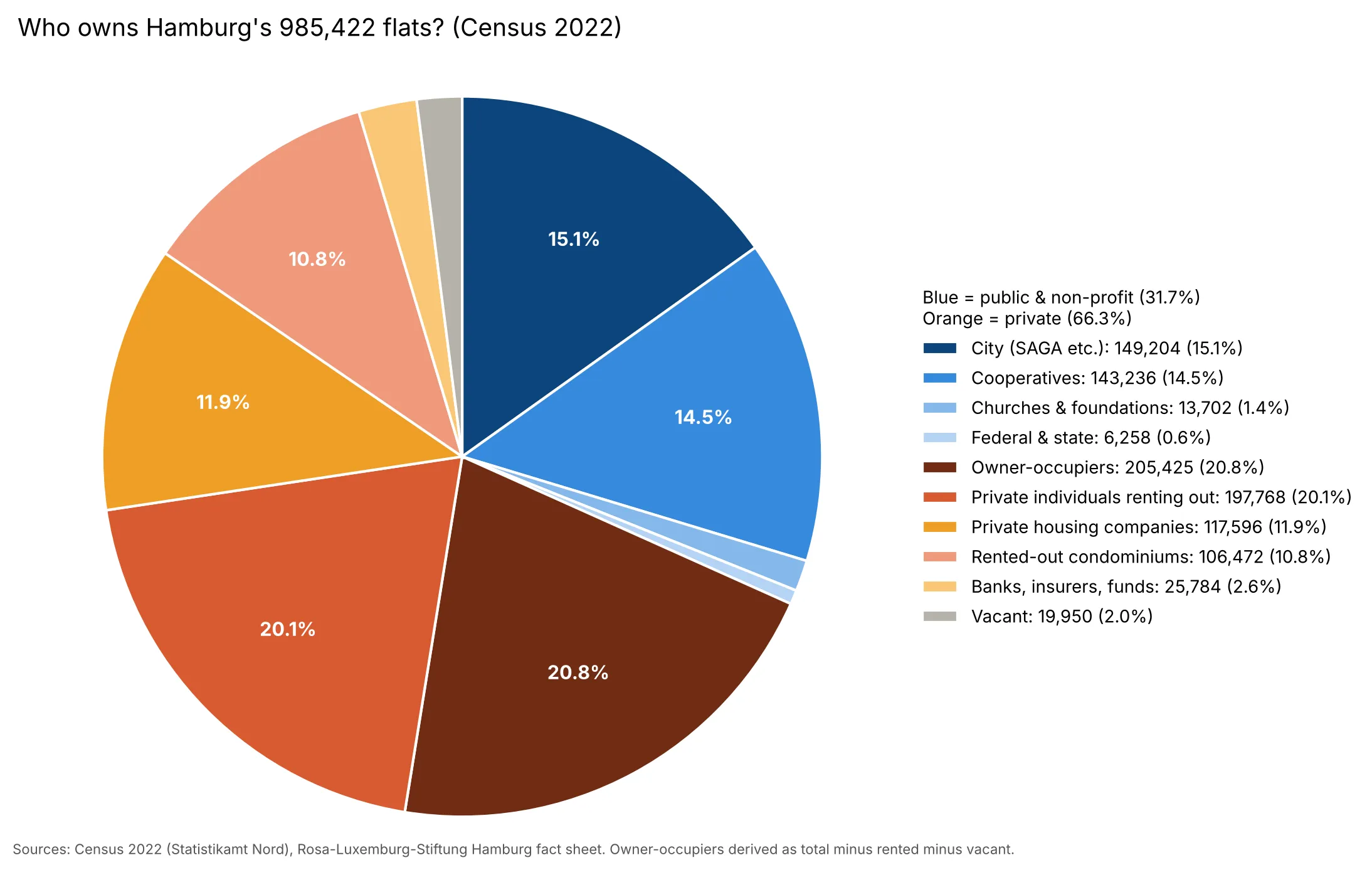
The second one is who owns the rented flats. Around 32% of flats belong to the city (like SAGA) or to non-profit cooperatives, which offer affordable housing. Another 32% belong to private companies and individuals who rent them out. Some of these companies are well known, like Vonovia and Heimstaden, which own thousands of flats in Hamburg. But the biggest share belongs to private individuals and family offices, and nobody really knows who they are. That deserves its own article, so I won't go into the details here.
When most flats are rented and so many are in private hands, it gets harder to buy your own home or to find a flat you can afford to rent. The most obvious way out is to build more. New buildings can help people own their home, create subsidised flats and relax the market, so rents rise more slowly or stay stable. The problem is that the Hamburg Senate's goal is to approve 10.000 new flats every year, and it hasn't reached it for years. In 2024, the city approved only around 4.600 new flats, and in 2025 it was 6.676.
There could be many reasons for this, like regulations or rising costs. But one of them is probably space. If you move to Hamburg, you want to enjoy the city as much as possible and live close to the office, restaurants and parks, and there isn't much free land left in those areas. I was thinking about this while taking a walk past some Kleingärten, and I started to wonder: why don't we turn Kleingärten into living spaces?
What is a Kleingarten?
A Kleingarten, also called a Schrebergarten, is a small garden that you rent inside a larger group of gardens run by a Verein (club). The idea goes back to the 19th century, when many workers lived in small, crowded flats. The garden gave them a place outside their home: after work and on Sundays, they could go there, get some fresh air and grow their own vegetables. It was meant for spending time, not for living, and that is still the rule today.
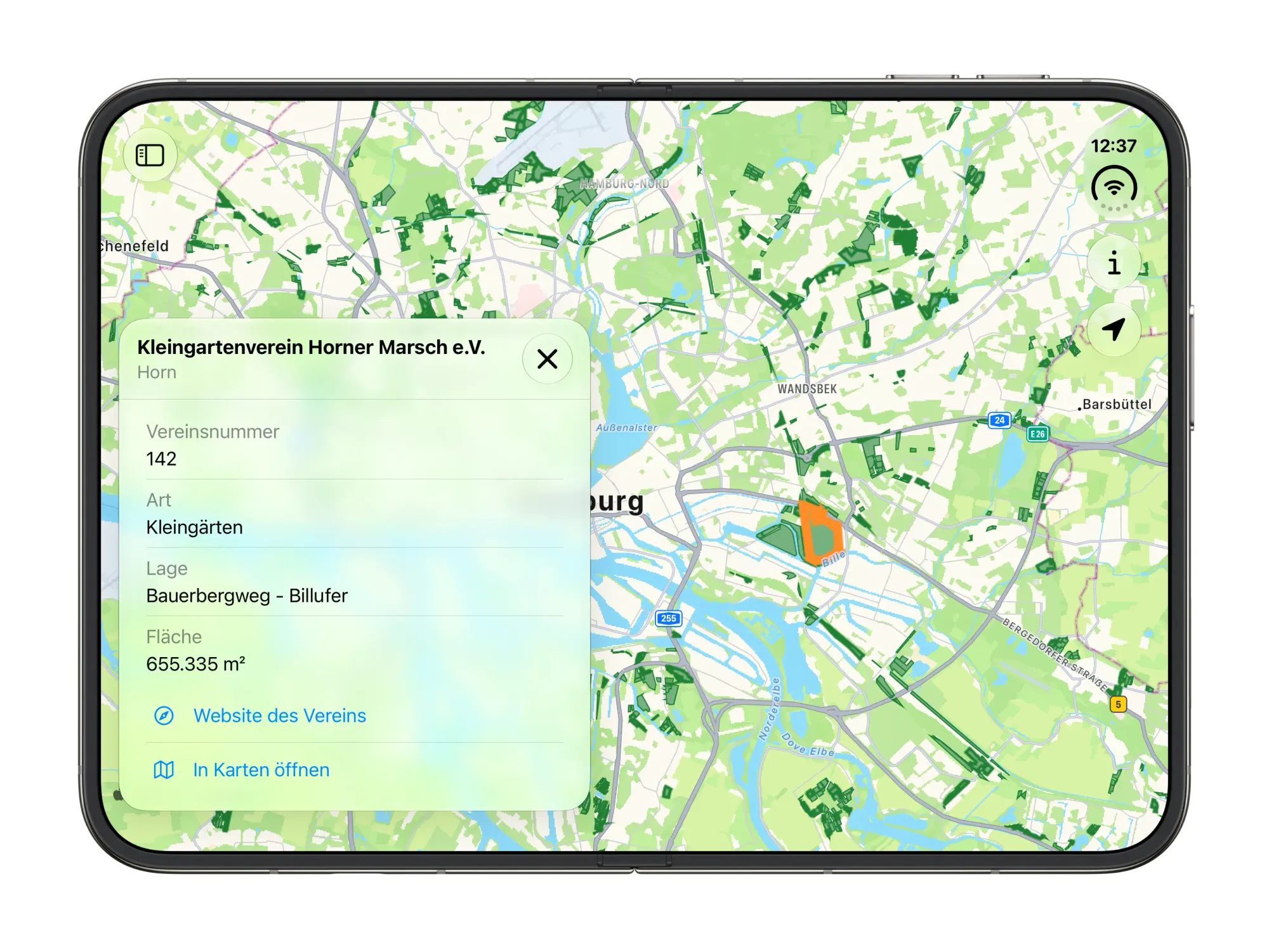
Getting a Kleingarten is not easy, even though Hamburg has more than 33.000 of them, covering about 14 km², more than nine times the size of the Stadtpark. One reason is that they are quite affordable, so many people want one. All yearly costs, including the membership fee, usually come to around 300 to 400 euros. When you take over a garden, you only pay the previous tenant for the hut on the plot, on average just over 4.000 euros in Hamburg. I've been looking for a Kleingarten for years, and it feels almost impossible because there are not many available.
When the first Kleingärten were created, many of them were on the edge of the city, on land that nobody needed yet. But the city has grown, and many are now right next to where people live.
This is where I started to see a problem. In a Kleingarten area, each garden is used by just one household, mostly in the evenings and at weekends in the warmer months. With new buildings and a green courtyard, the same land could be home to many more people who use it every day. This might sound controversial, but when I did some research, I found out that this idea has actually been tried!
Pergolenviertel
Pergolenviertel lies in Winterhude, on the eastern side of the Stadtpark, between the office towers of City Nord and the S-Bahn line, with the stations Alte Wöhr and Rübenkamp at its edges. It is quite a nice spot: the park is only a short walk away, and the S-Bahn takes you into the city.
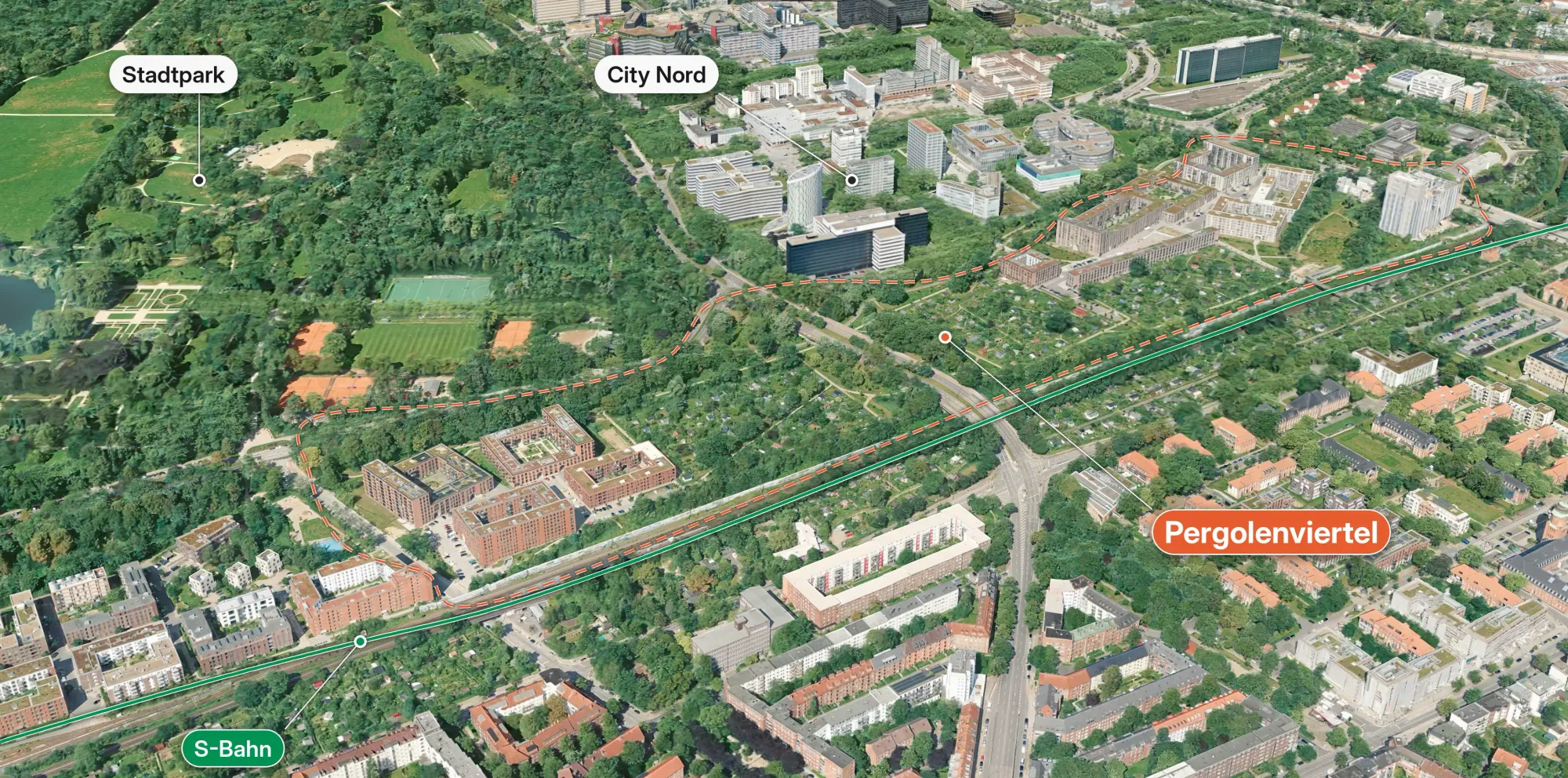
For almost a hundred years, this land was full of Kleingärten, around 320 of them. The city tried to build on it again and again: a housing plan in 1908, a bigger Stadtpark in the Nazi era, a motorway in the 1960s and sports halls in the 1990s. The very first one was rejected by Fritz Schumacher because it had too little green space. Every time, the plans stalled. You can still see one of them today: the cycle path next to the neighbourhood runs on the strip that was kept free for the motorway.
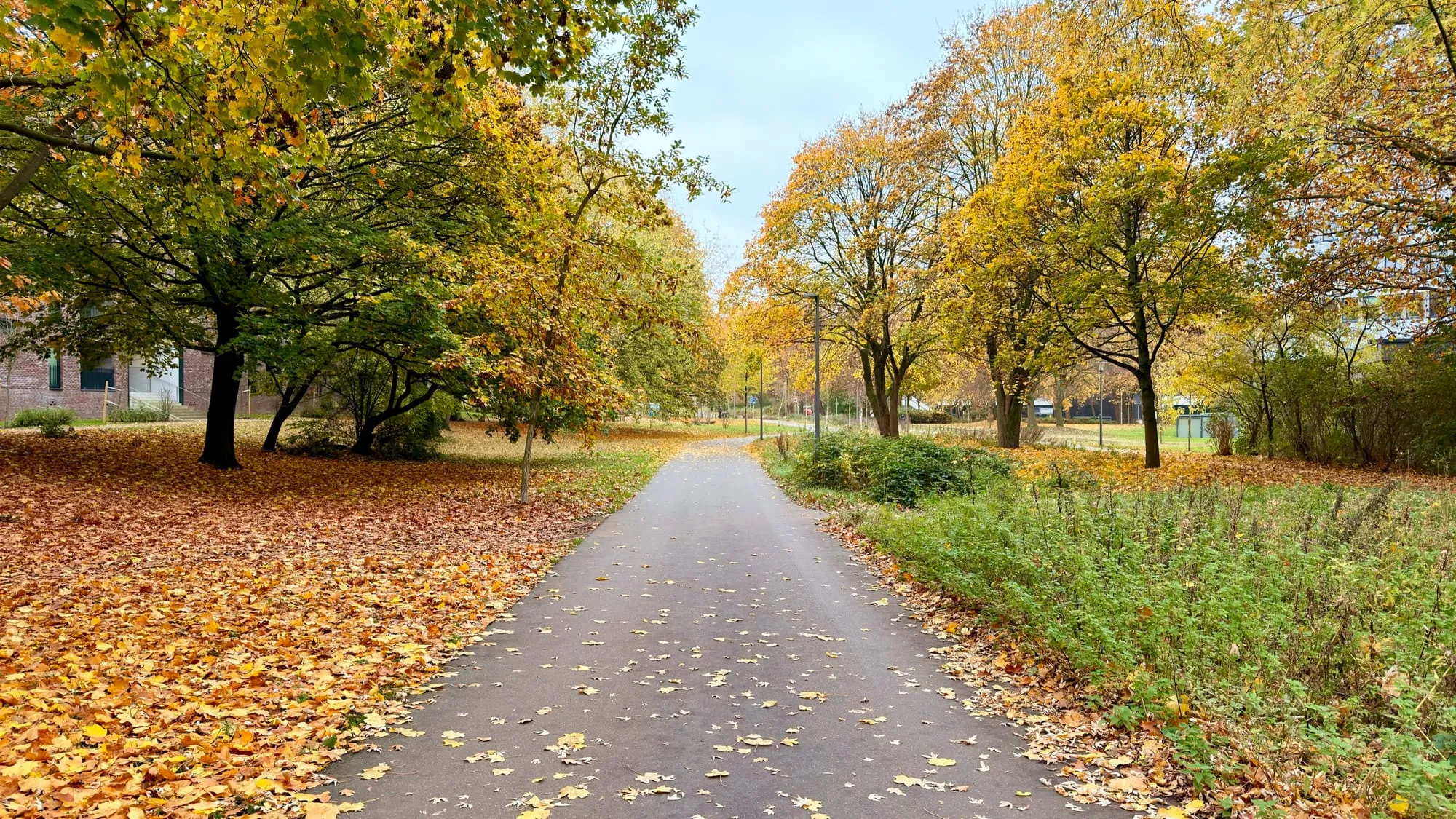
Around 2010, the district of Hamburg-Nord decided to build homes here itself. Not everyone was happy about it. The gardeners started an initiative called "Eden für Jeden" and collected more than 10.000 signatures, but in 2015 the courts ruled in favour of the plan. The first gardens were cleared in 2016, and the first residents moved in in 2019.
Today, the neighbourhood has about 1.700 homes for up to 4.000 people. 60% of them are subsidised, 27% are rented at market prices and 13% are owner-occupied. There are also 200 subsidised student flats, around 150 places for care and assisted living, and three Kitas with about 300 places. The tallest building, Perigon, is 57 m high and was finished in 2025.
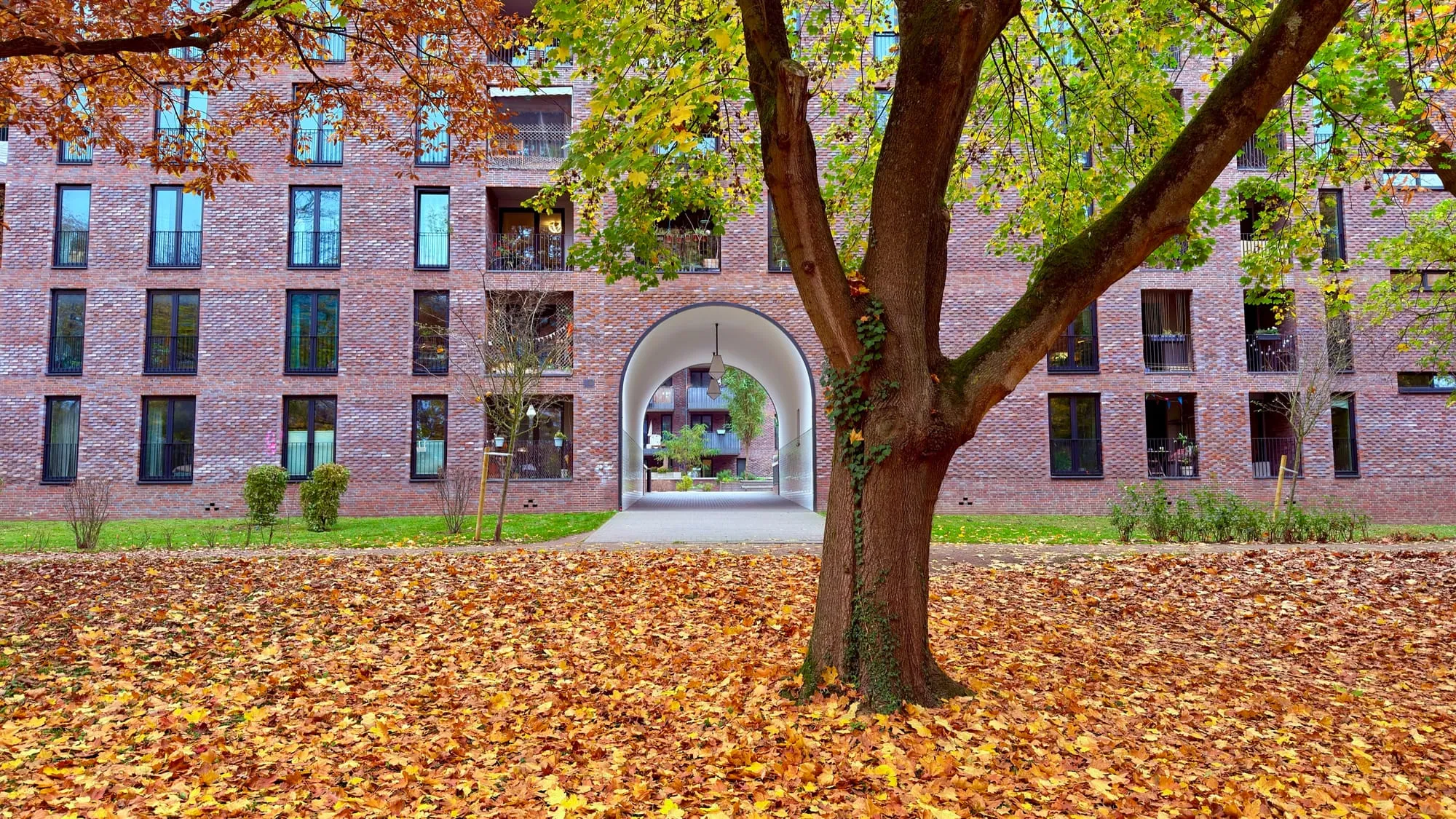
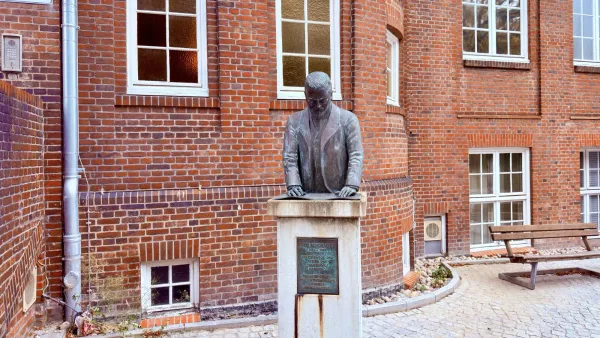
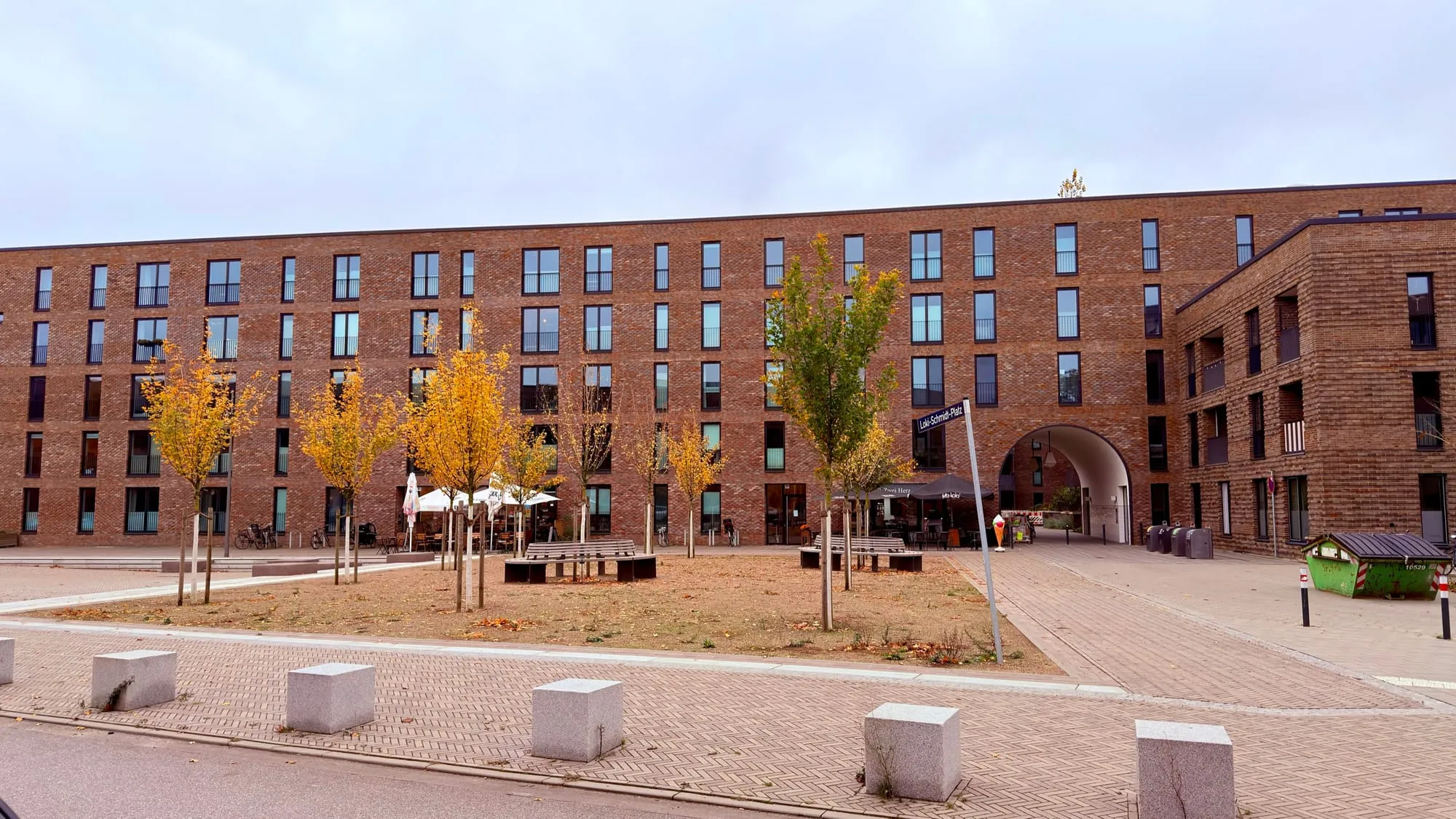
When you walk through, you start to notice the small details. The red brick is a nod to Schumacher: the buildings borrow from his estates, like the Jarrestadt nearby. The colour of the brick also changes from a light reddish grey in the north, matching City Nord, to a dark red in the south, matching the older houses at Alte Wöhr. The hawthorn trees do the opposite: they bloom pink-red in the north and white in the south. In the middle is Loki-Schmidt-Platz, with wide steps facing the sun, which also works as a rain basin and can flood on purpose during heavy rain. The neighbourhood was also planned for fewer cars, with cargo bikes to rent and car sharing, and today there are only about 0,4 cars per household.
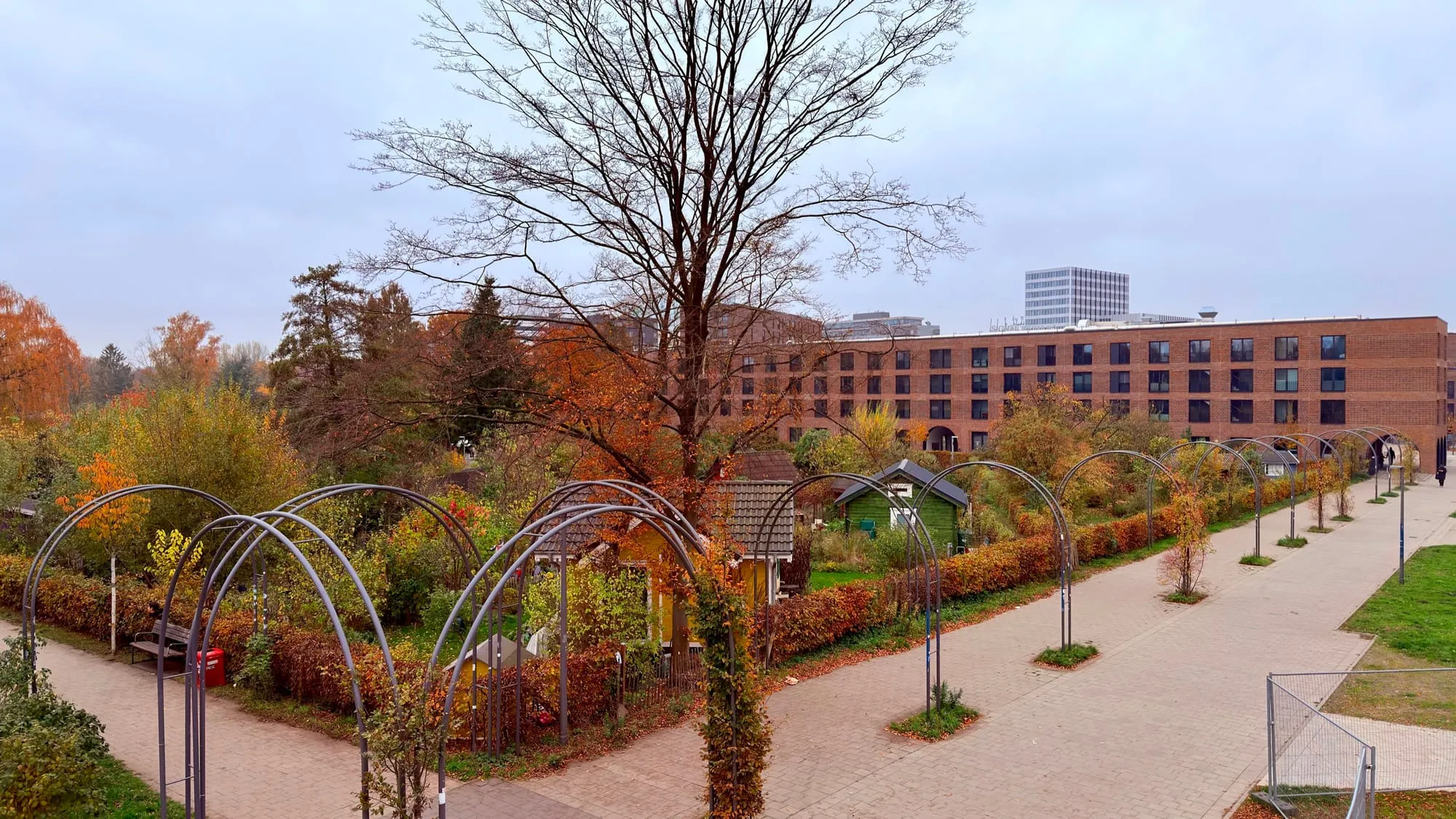
The Kleingärten didn't disappear, though. Instead of pushing them to the edge, the architects put them in the middle: 171 gardens on about 6 hectares, now permanently protected and framed by more than 100 steel pergolas, which gave the neighbourhood its name. The same round arch shape also appears on the buildings, where arched passageways lead into the courtyards. About 150 more gardens were replaced elsewhere, at Saarlandstraße and in Langenhorn. But the gardens are smaller now: some of the old plots were up to 1.000 m², while today the limit is 400 m².
Could this work elsewhere in Hamburg?
When I look at what happened in Pergolenviertel, I think it is a huge achievement: the city built a whole new neighbourhood and still kept the gardens, just smaller and partly in other places. Of course, I'm completely against replacing green areas like parks with housing. But to me, a Kleingarten is different: compared to a park, it's a private space, often without many trees.
Still, not every Kleingarten in Hamburg would be suitable for this kind of project, since they come in very different sizes. And I'm a huge fan of the Kleingarten concept myself, which is why I'm still looking for one. So one idea could be to create more Kleingärten close to public transport in the areas where the city is planning to grow. This would allow more people to have a Kleingarten while the city develops those areas. Eventually, some of these gardeners might even consider moving there once new buildings pop up. In this way, Kleingärten could be the first step in developing new districts.
Building more is only one way to improve the housing situation. Berlin is looking at the other problem I mentioned at the start: who owns the flats. The parties now negotiating a new government there, Die Linke, the Greens and the SPD, plan to take over flats from companies that own more than 10.000 flats in the city, in return for compensation.
Back in Hamburg, there are also projects that turn offices into homes. I remember reading about one in Bergedorf, where an empty office building from the 1960s will be turned into 32 flats, with construction starting this autumn. This makes complete sense to me, because around the city I see many offices that have been offering thousands of square metres for rent for years, and no company wants to rent them.
Another idea is a land value tax. If land is not used well, like a parking lot or a single-storey supermarket, the owners would pay higher taxes. This could push them to build homes there, with the parking underground and the supermarket on the ground floor. A friend of mine, for example, lives in a very popular district next to a scrapyard full of old cars that has looked the same for years.
I don't know exactly how the city is planning to solve the housing situation in Hamburg. I just see that setting a target and missing it year after year doesn't seem to be working.