What’s going on with HafenCity’s street names?
What Shanghaiallee, Miamiplatz and a bridge named after Gandhi tell us about HafenCity.
Last week, my brother came to visit me for the first time, so I spent a few days showing him the city. We did the usual things: the Speicherstadt, Miniatur Wunderland and the Elbphilharmonie. In HafenCity we also stopped by Westfield so he could do some shopping, and the Prototyp car museum so he could look at the cars, even though cars are not really my thing.
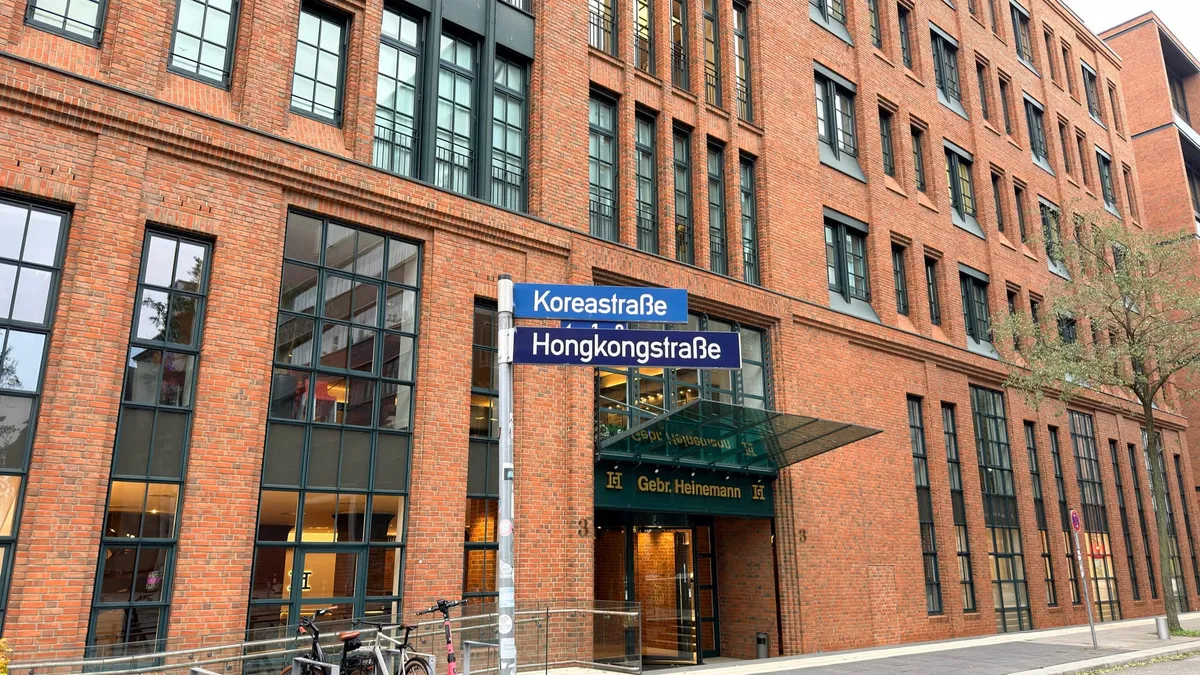
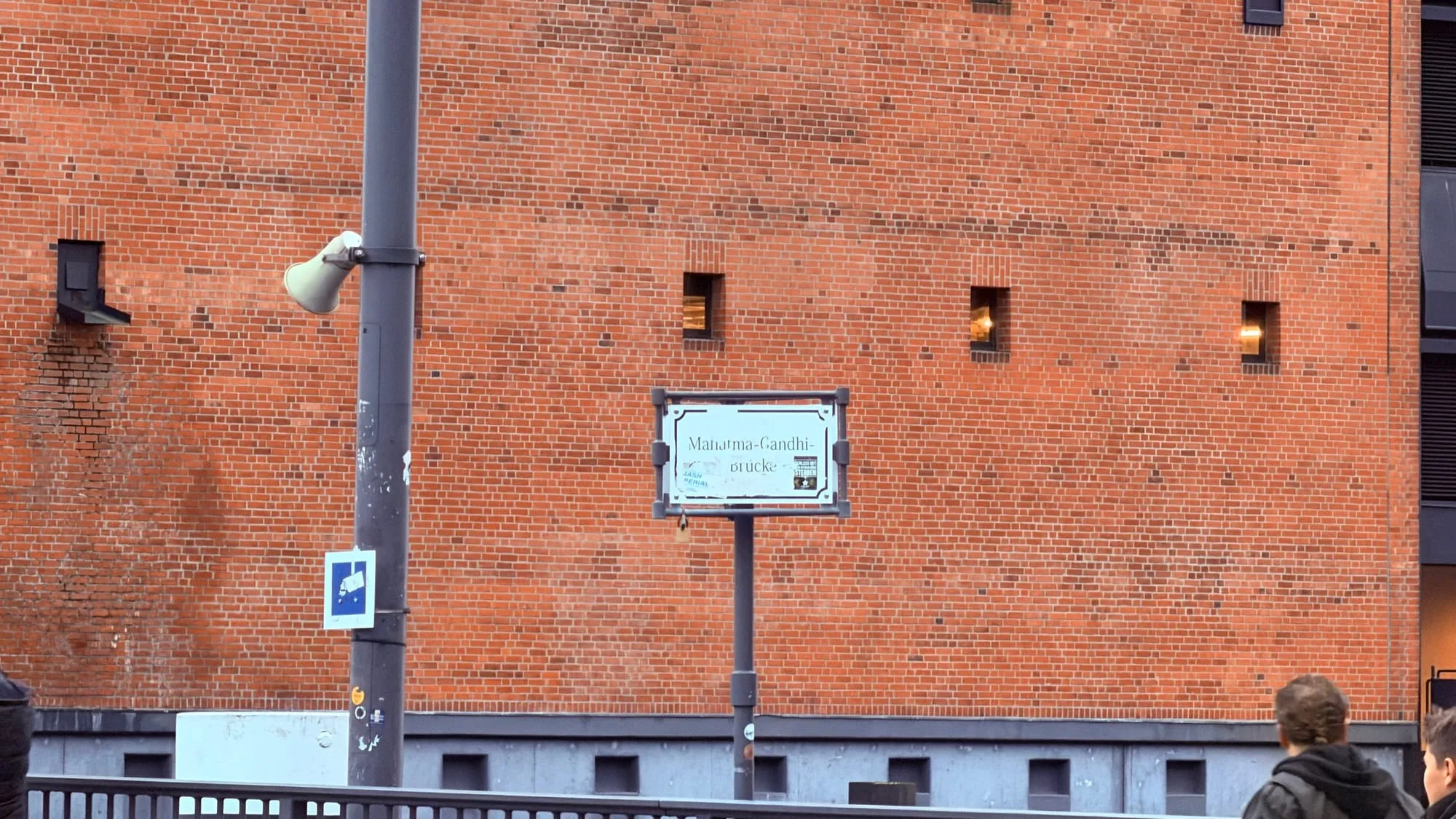
While we were walking around HafenCity, I started paying attention to the street names. Some of them, like Koreastraße and Hongkongstraße, made me think they were named after the places Hamburg trades with. That seemed like a good enough reason, until I remembered the bridge that leads to the Elbphilharmonie. It is called the Mahatma-Gandhi-Brücke, and I could not see what Gandhi had to do with trade. Then, on our way back home, we took the U4 for the first time, and around the Überseequartier station we saw one American city name after another. At that point, I really wanted to understand the reasoning behind all these names. It turns out there is a system behind them, and there have been quite a few arguments about it too.
HafenCity
First, a bit about HafenCity itself. For a long time this area was a working port, full of quays, warehouses and railway tracks, and closed off behind the fence of the free port. When the port moved most of its work to the bigger terminals across the Elbe, these old harbour basins were not really needed any more. In 1997, the mayor at the time, Henning Voscherau, presented the idea of bringing the city centre back to the water. The first residents moved in in 2005, and in 2008 HafenCity officially became its own district.
The whole area covers 157 hectares and makes Hamburg's city centre about 40 percent bigger. It is often called the largest inner-city development project in Europe. When it is finished, about 15.000 people should live here and about 45.000 people should work here, and most of it should be done by around 2030.
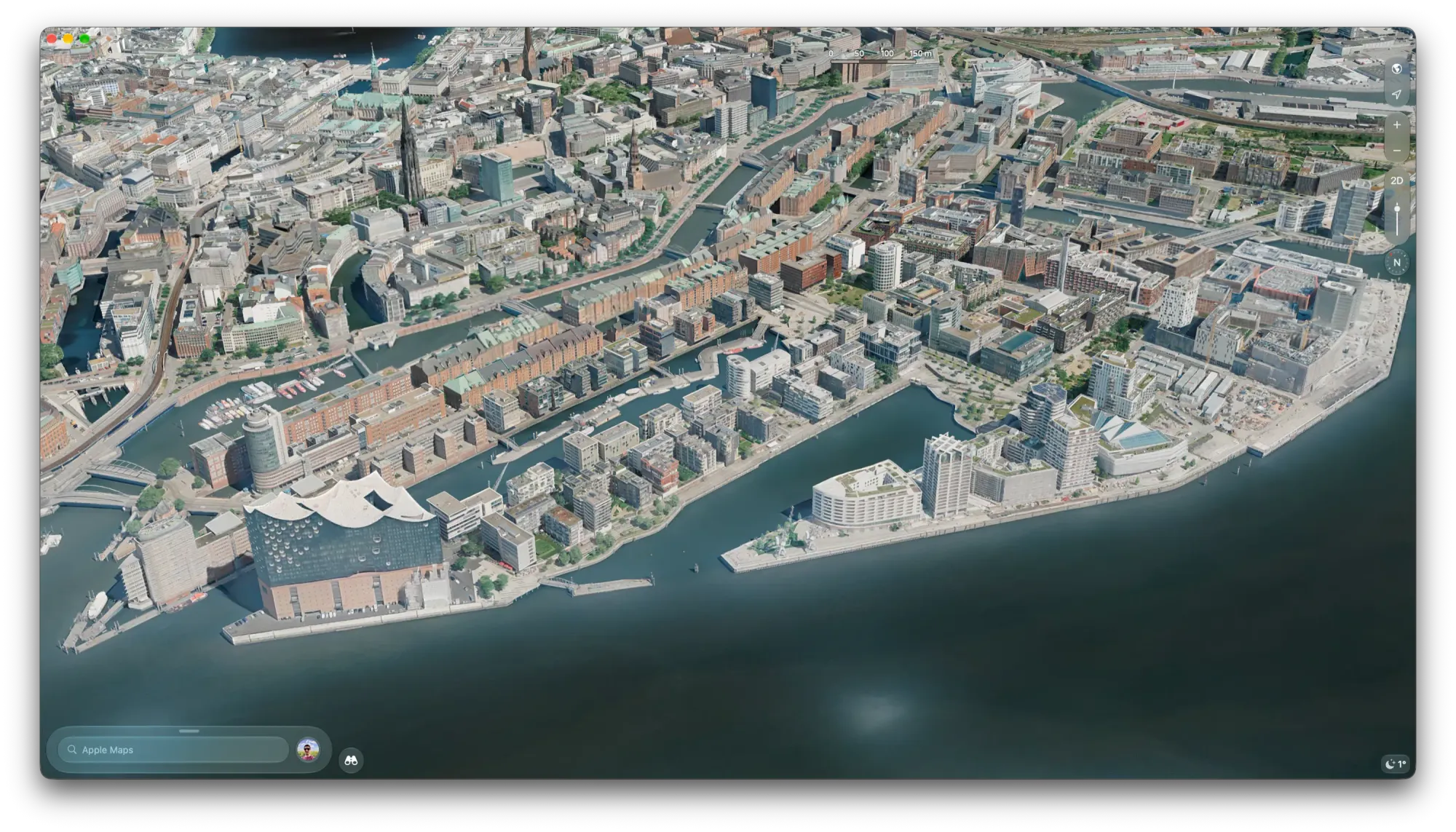
There is a lot more to say about HafenCity, like how it is built to handle floods or the half-built Elbtower, and it probably deserves its own article at some point. For now, I want to stay with the names. Building a district almost from zero also means naming it almost from zero. Today there are 119 named streets, squares, quays and bridges in HafenCity, and about half of them got their names in the last twenty years.
The Speicherstadt
The Speicherstadt officially belongs to HafenCity, and its names are a lot older than the rest. Many of them come from the neighbourhood that stood there before the warehouses. Kehrwieder means a dead end where you have to turn back. Alter and Neuer Wandrahm come from the cloth makers who dried their cloth on wooden frames there. Holländischer Brook is named after Dutch settlers, Kannengießerort after the pewterers who made jugs, and the Kibbelsteg after the old word "kibbeln", which means to chat.
This neighbourhood had to make way for the port. When Hamburg joined the German customs union in the 1880s, it was allowed to keep a free port, but it needed big warehouses inside it. So from 1883, the Kehrwieder and Wandrahm quarters were cleared and torn down: about 1.000 houses, and around 20.000 people had to leave their homes. Rich merchants lived on the Wandrahm in fine baroque houses, while the Kehrwieder was home to port workers and craftsmen in small, crowded houses. Many of the workers needed to stay close to the port, so they moved into other poor and overcrowded areas nearby. The warehouses were built step by step until 1927, and the old street names are mostly what is left of the people who lived there.
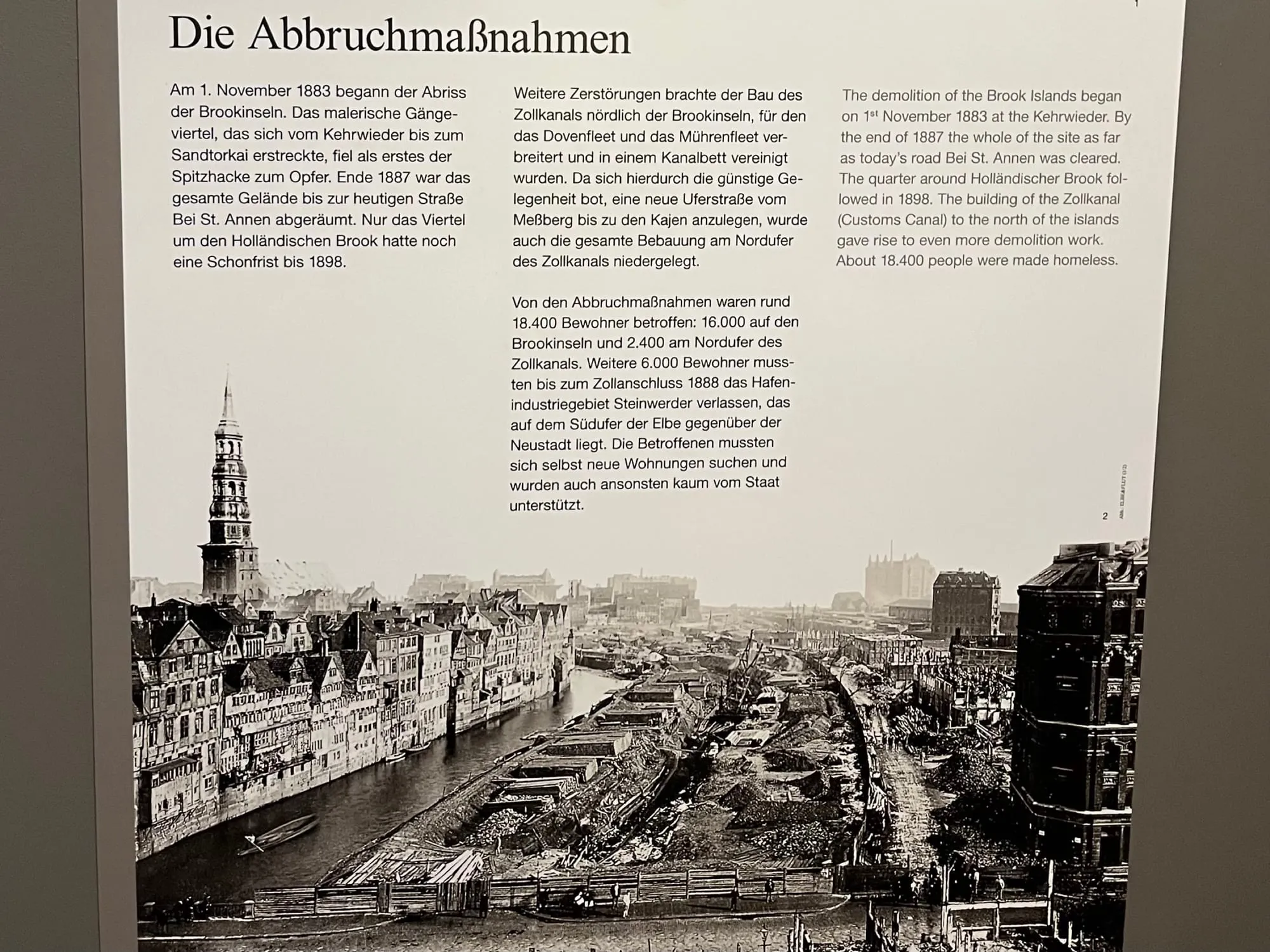
If you want to learn more about this, I can recommend the Speicherstadtmuseum at Am Sandtorkai 36. It is inside one of the warehouses from 1888 and shows how the Speicherstadt was built and how people worked there, with old tools and goods like coffee and tea. They also offer guided tours, some of them in English.
The port founders
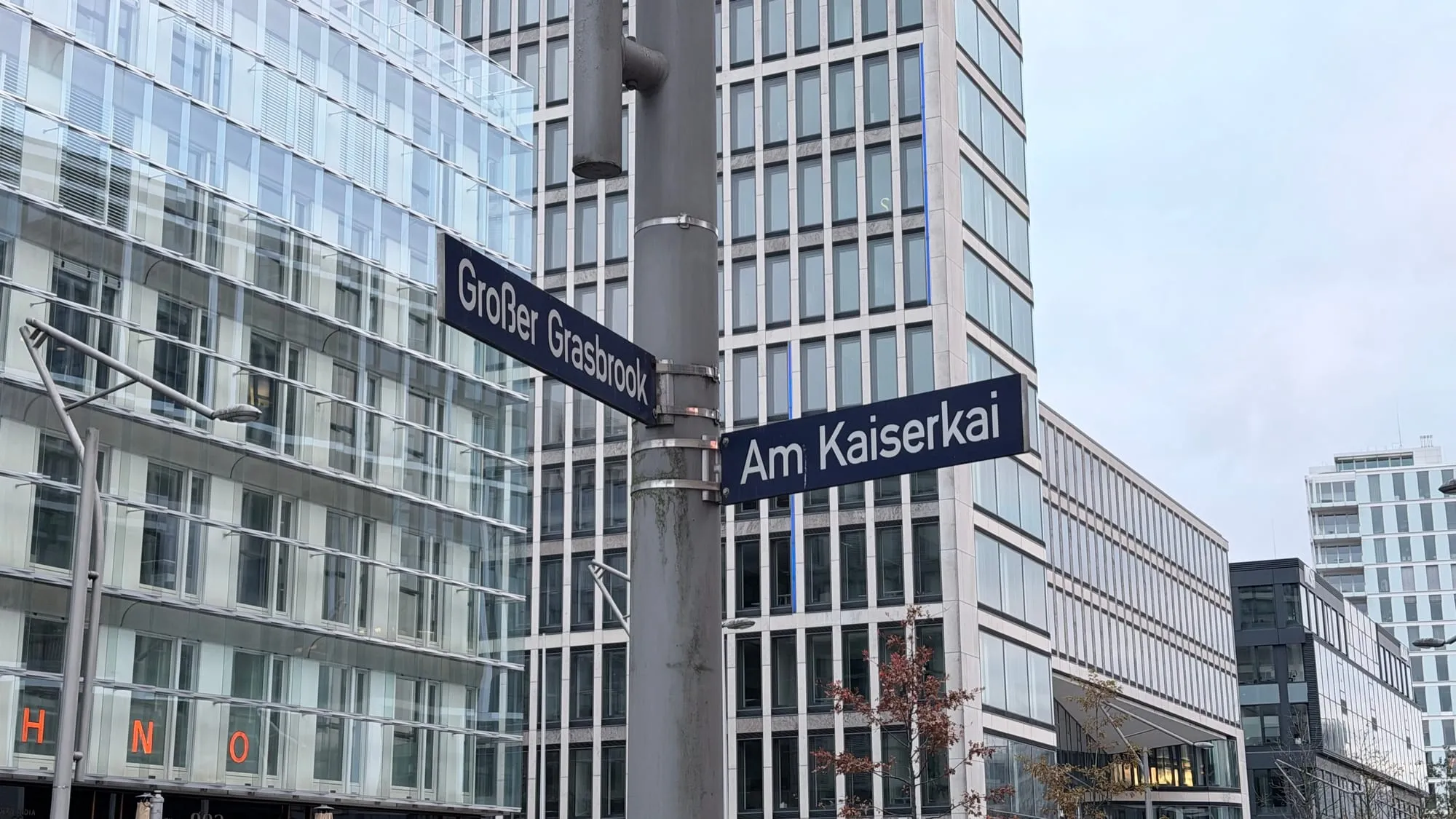
Many addresses in HafenCity, like Am Kaiserkai or Am Dalmannkai, go back to the old quays. Most of these quays were named between 1865 and 1890 after the men who built the port, like the harbour engineer Johannes Dalmann or the senator Johannes Versmann, whose deal with Berlin in 1881 created the free port and the Speicherstadt. Others are named after mayors, like the Petersenkai and the Kirchenpauerkai, and the Kaiserkai, where the Elbphilharmonie stands, is named after Wilhelm I, the first German emperor. My favourite in this group is Stockmeyerstraße, named after the industrialist Heinrich Christian Meyer, who got the nickname "Stockmeyer" because he sold walking sticks (Stöcke) as a child.
The port geography
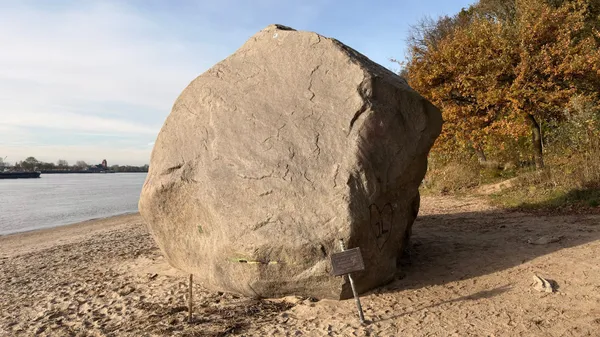
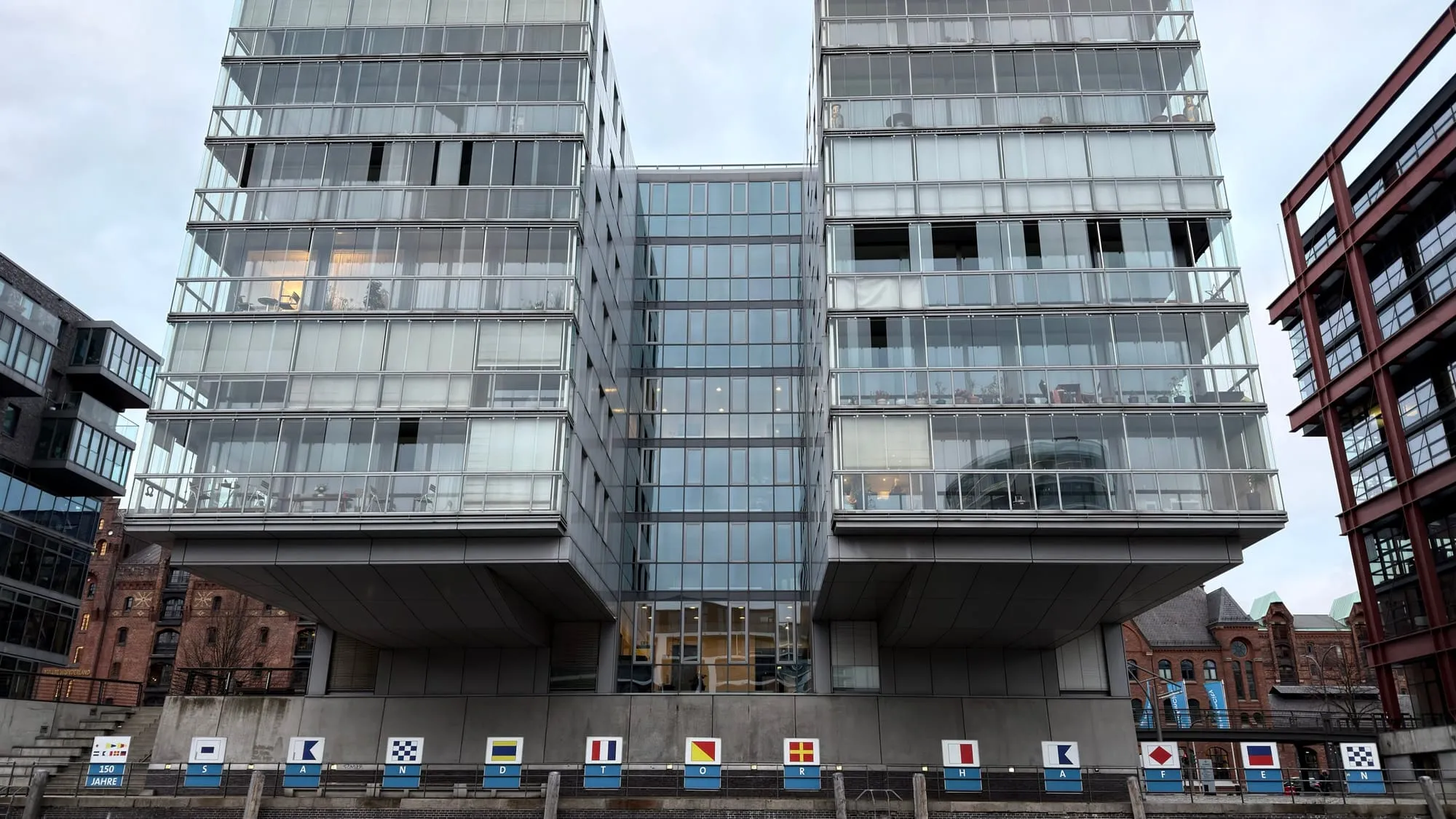
Many names in HafenCity do not honour anyone at all, they simply describe the place. The district is built on the Grasbrook, an old marsh island in the Elbe, and Grandeswerder Straße and Baakenwerder Straße remember two former islands nearby. The quays are named after their harbour basins, like Sandtorkai or Strandkai, and the tip of a quay is called a "Höft", which is why you find Kaiserhöft and Sandtorhöft. There is even a Platz am 10. Längengrad, a square that simply sits on the 10th meridian east. These names are easy to walk past, but together they keep a record of what this land looked like before HafenCity.
The explorers
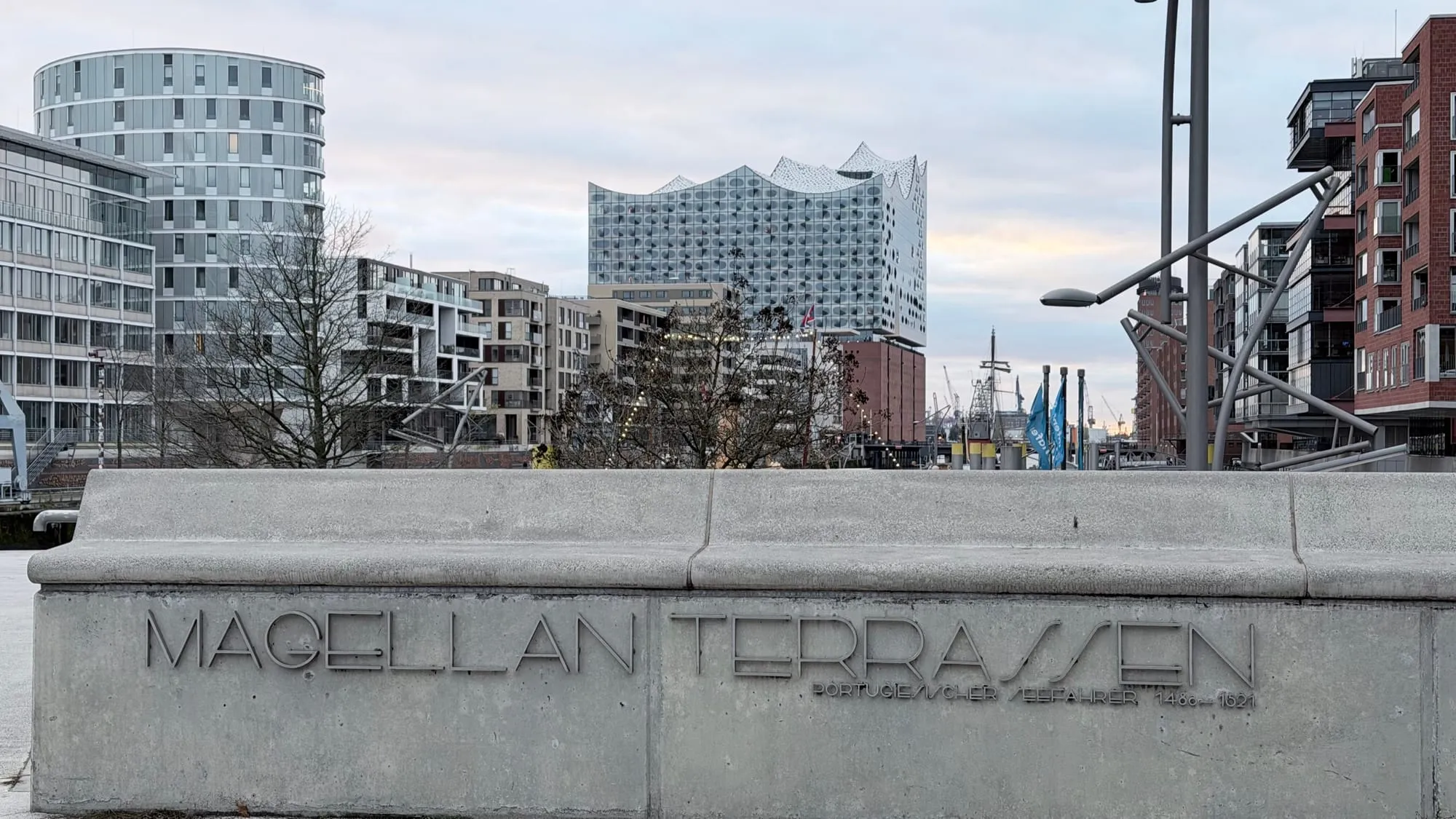
The first new names HafenCity got, in 2005, were explorers. The three big public spaces in the western part were named Magellan-Terrassen, Marco-Polo-Terrassen and Vasco-da-Gama-Platz. In 2013, the Amerigo-Vespucci-Platz followed near the Elbbrücken, and today it is the largest square in HafenCity. The explorers were chosen to stand for the beginning of world trade.
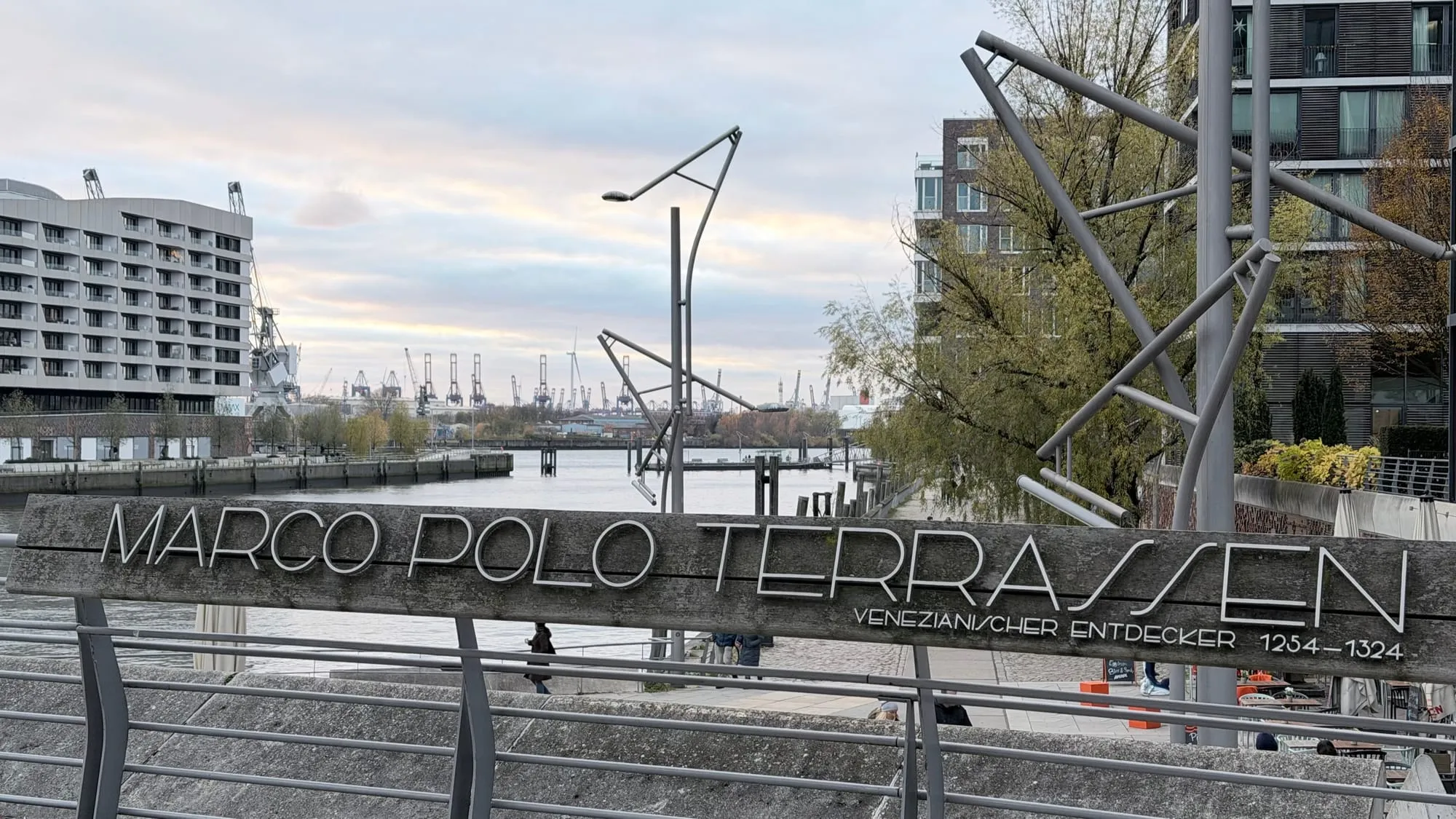
Each of them opened a door that trade later went through. Marco Polo travelled from Venice to China in the 13th century, and his book about the journey showed Europeans how rich Asia was. Vasco da Gama was the first European to reach India by sea, sailing around Africa in 1498. Amerigo Vespucci understood that the lands Columbus had reached were not part of Asia but a new continent, and America was named after him. And Magellan led the first expedition to sail around the whole world, even though he died on the way.
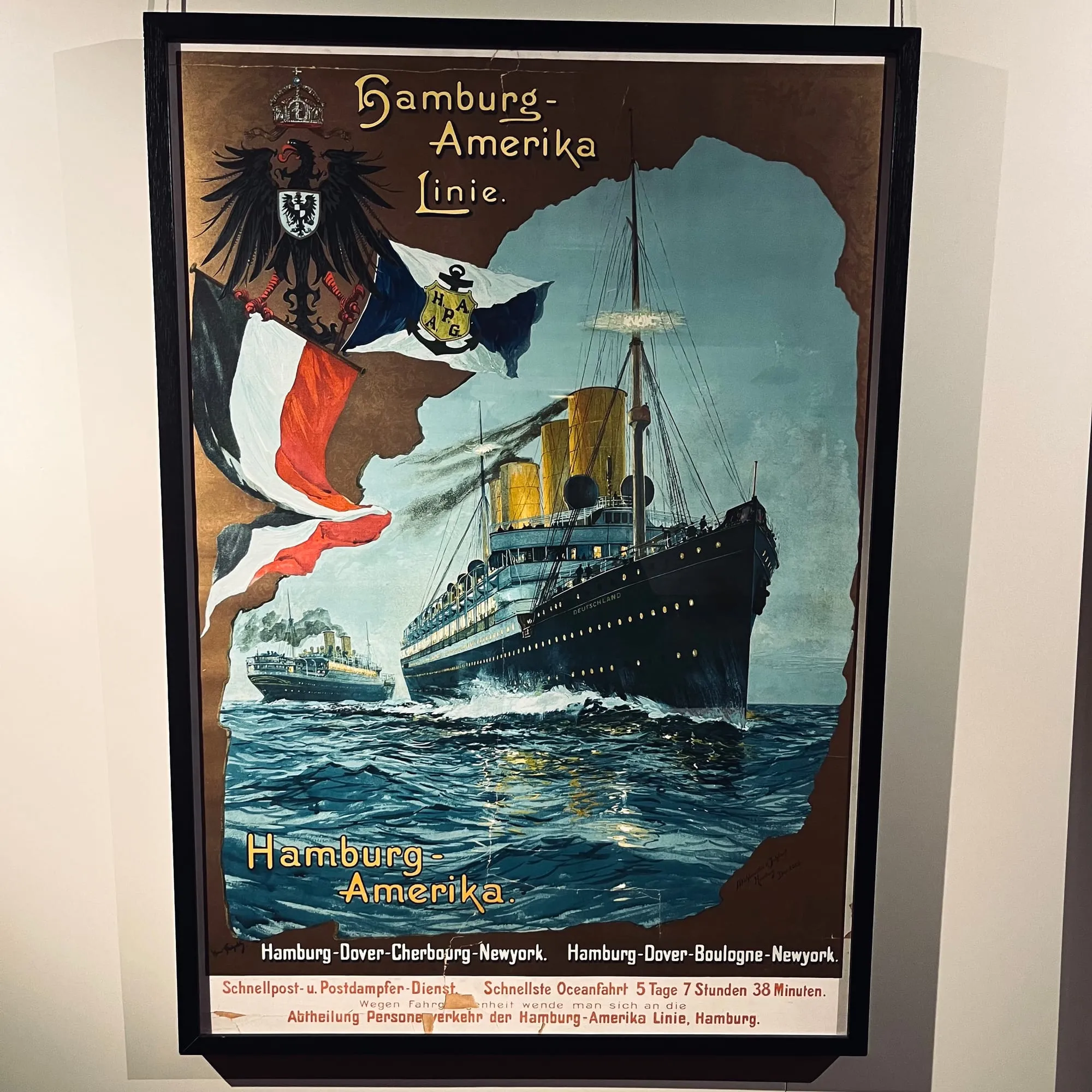
For Hamburg, this changed a lot. Until then, the city traded mostly around the North Sea and the Baltic Sea. The discovery of America gave its trade a big push, and by the end of the 18th century, sugar and coffee alone made up more than 60 percent of the city's overseas imports. In the 19th century, the Hamburg America Line was founded, bringing cotton and tobacco from America and taking hundreds of thousands of emigrants to the United States. I first heard about this line at the International Maritime Museum here in HafenCity, where I saw a bunch of its old posters. In the same century, Hamburg's population grew from about 130.000 to 700.000.
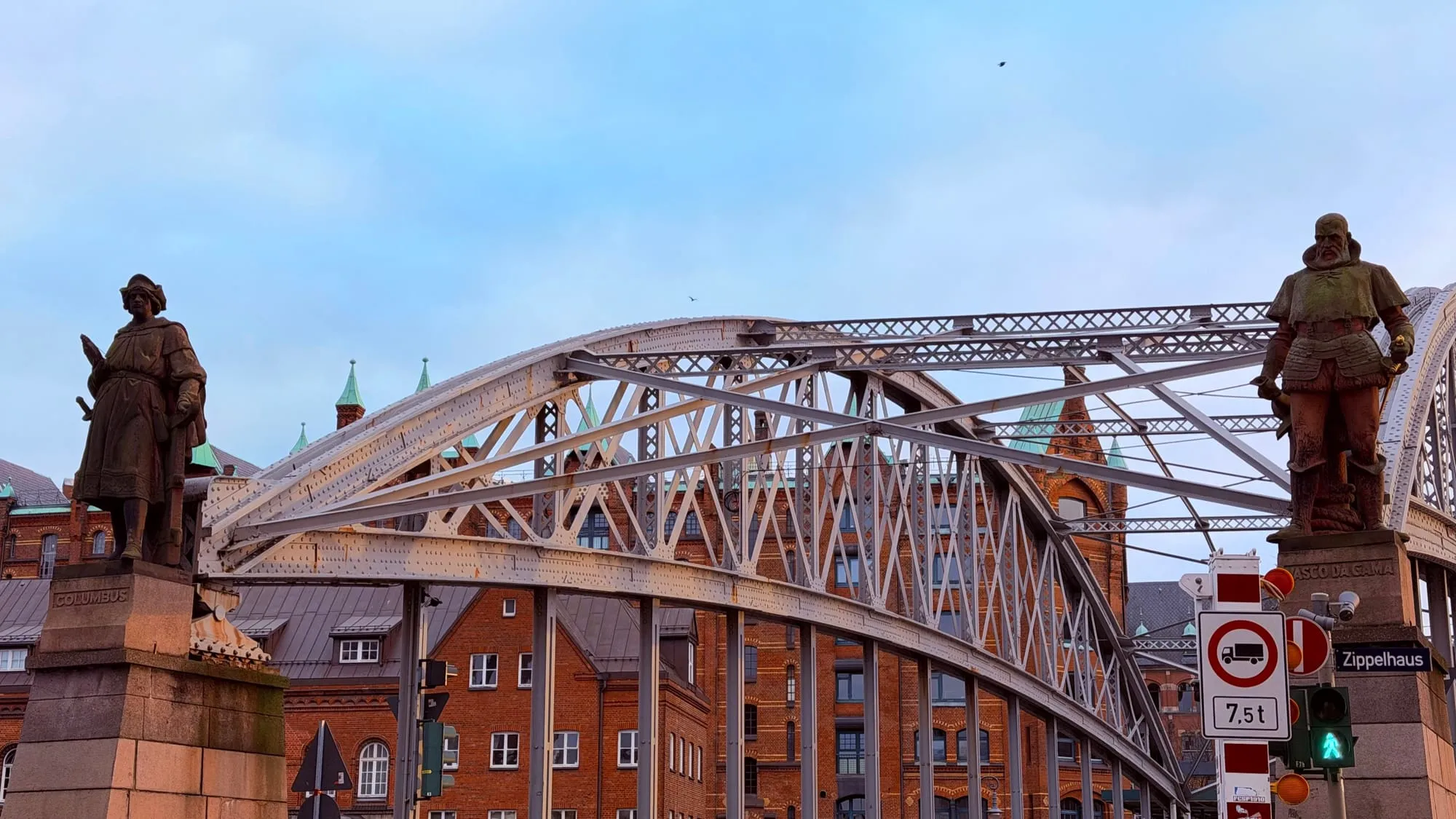
So the explorer names are not random. Without the routes they opened, Hamburg would not have become the port city it is, and there would be no Speicherstadt or HafenCity to name. The city had the same idea more than a hundred years ago: in 1903, statues of Columbus, Vasco da Gama, James Cook and Magellan were put up on the Kornhausbrücke to celebrate the overseas trade of the new free port. Columbus and Vasco da Gama are still standing there today, but Cook and Magellan were destroyed in a bombing raid in 1944. The explorers also appear on some of the buildings, like the Vespucci-Haus, Columbus-Haus, Humboldt-Haus and Amundsen-Haus at the western tip of HafenCity, and the Marco-Polo-Tower next to the square with the same name.
The port cities
The biggest group of names is the one that made me curious in the first place: port cities. Most of them are in the Überseequartier, which literally means "overseas quarter", and in the Elbtorquartier next to it. The first ones were given in 2006, more followed in 2013, and new ones are still being added.
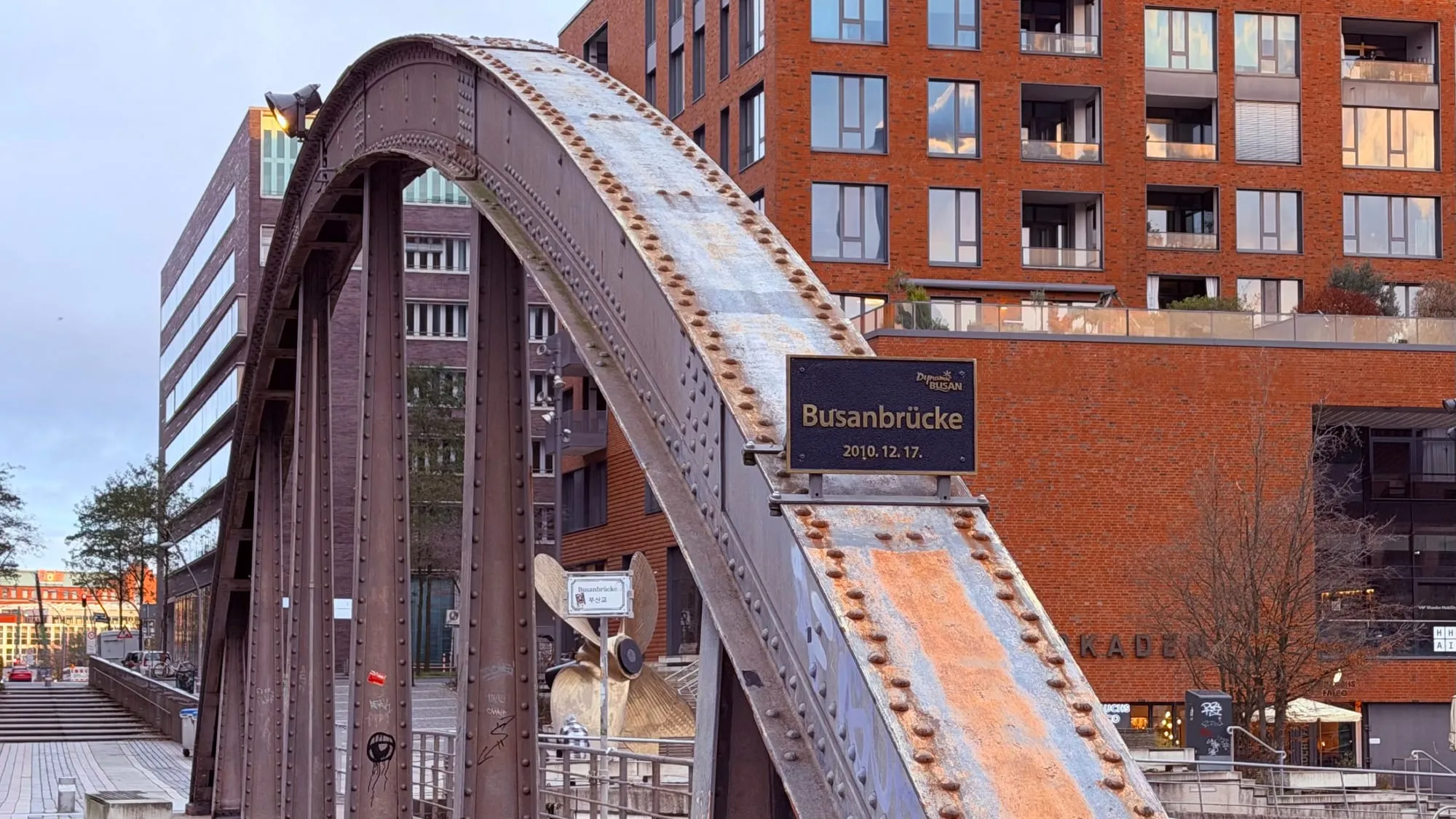
On the Asian side there are Shanghaiallee, Osakaallee, Tokiostraße, Hongkongstraße, Singapurstraße, Yokohamastraße and Kobestraße, plus the Shanghaibrücke and the Busanbrücke. Koreastraße is the only one named after a country instead of a city. These names make a lot of sense when you look at where Hamburg's trade goes today. China is by far the port's biggest trading partner, and more than a quarter of all containers handled in Hamburg come from or go to China. Two of the names are also Hamburg's partner cities: Shanghai since 1986, so the partnership turns 40 this year, and Osaka since 1989. Both are, like Hamburg, home to their country's biggest port. The newest name in this group is the Kaohsiungbrücke, a small bridge whose signs went up in October 2025. It marks the port partnership between Hamburg and Kaohsiung in Taiwan, which goes back to 1999.
On the American side there are San-Francisco-Straße, New-Orleans-Straße, Chicagokai, Chicagostraße, Vancouverstraße and Buenos-Aires-Kai. Chicago is also a partner city, since 1994, and in 2024 the US was the port's second biggest trading partner after China. The latest additions came in 2024, when the southern part of the Überseequartier was finished and got Baltimorestraße and Miamiplatz, chosen on purpose to fit the group of North American port cities.
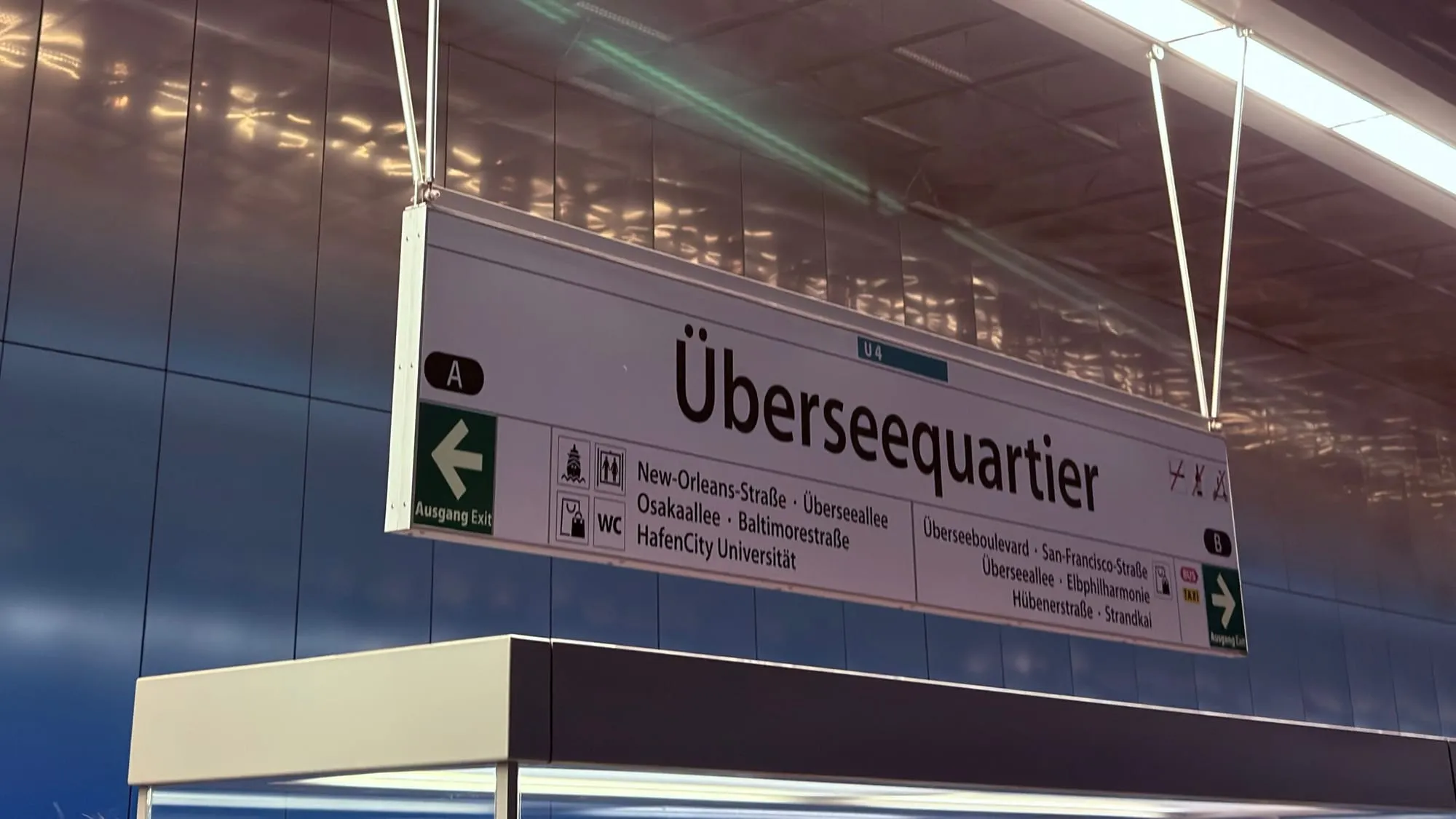
So my first guess on that walk with my brother was not wrong. A big part of HafenCity's map really is a list of the places Hamburg trades with, at least in theory. But not every name fits this pattern so neatly, and that is where the Mahatma-Gandhi-Brücke comes in.
The controversies
Not everyone was happy with these names, and the arguments started almost right away. In 2006, the Greens and the SPD in the city parliament already criticised the new names in HafenCity for having little to do with Hamburg. It got worse in 2011, when three places were renamed after Hamburg's partner cities and ties abroad: the Sandtorhafenbrücke became the Mahatma-Gandhi-Brücke, St. Annen Platz became the Dar-es-Salaam-Platz, and the Museumsbrücke became the León-Brücke. What annoyed people most was that old local names were replaced. Even Hamburg's own World Heritage website admits that names like Mahatma-Gandhi-Brücke and Chicagokai were mocked for a long time.
By then, people were living in HafenCity, and they wanted a say. In 2011, the residents' association Netzwerk HafenCity started a working group on street names. They asked for names connected to the place and its trade routes, partners in Africa and South America too, more women, and their old names back. The biggest fight came in 2012, when a new street next to the Lohsepark was supposed to be called Hiroshimastraße. The Lohsepark stands where the Hannoverscher Bahnhof used to be, the station from which more than 8.000 Jews, Sinti and Roma were deported between 1940 and 1945. A street named after a city destroyed by an atomic bomb felt wrong in that place, and the name was never given. Today the street is called Am Lohsepark, and a memorial in the park remembers the people who were deported.
In the end, the residents and HafenCity Hamburg agreed on a joint list, and in 2013 the Senate adopted almost all of it. That is where the Buenos-Aires-Kai comes from, and also the first five women's names in HafenCity, among them Lucy Borchardt, a Jewish shipowner who helped Jews leave Germany before she had to flee herself, and the painter Gretchen Wohlwill, who lost her teaching job in 1933 because she was Jewish. At the time, about 2.000 streets in Hamburg were named after men and only about 300 after women. The old names did not come back, though. In Hamburg, a name can only be changed if it causes confusion or honours someone with a Nazi or colonial past, so the Gandhi bridge and the Dar-es-Salaam-Platz stayed. The city only named a new square next to it St. Annenplatz.
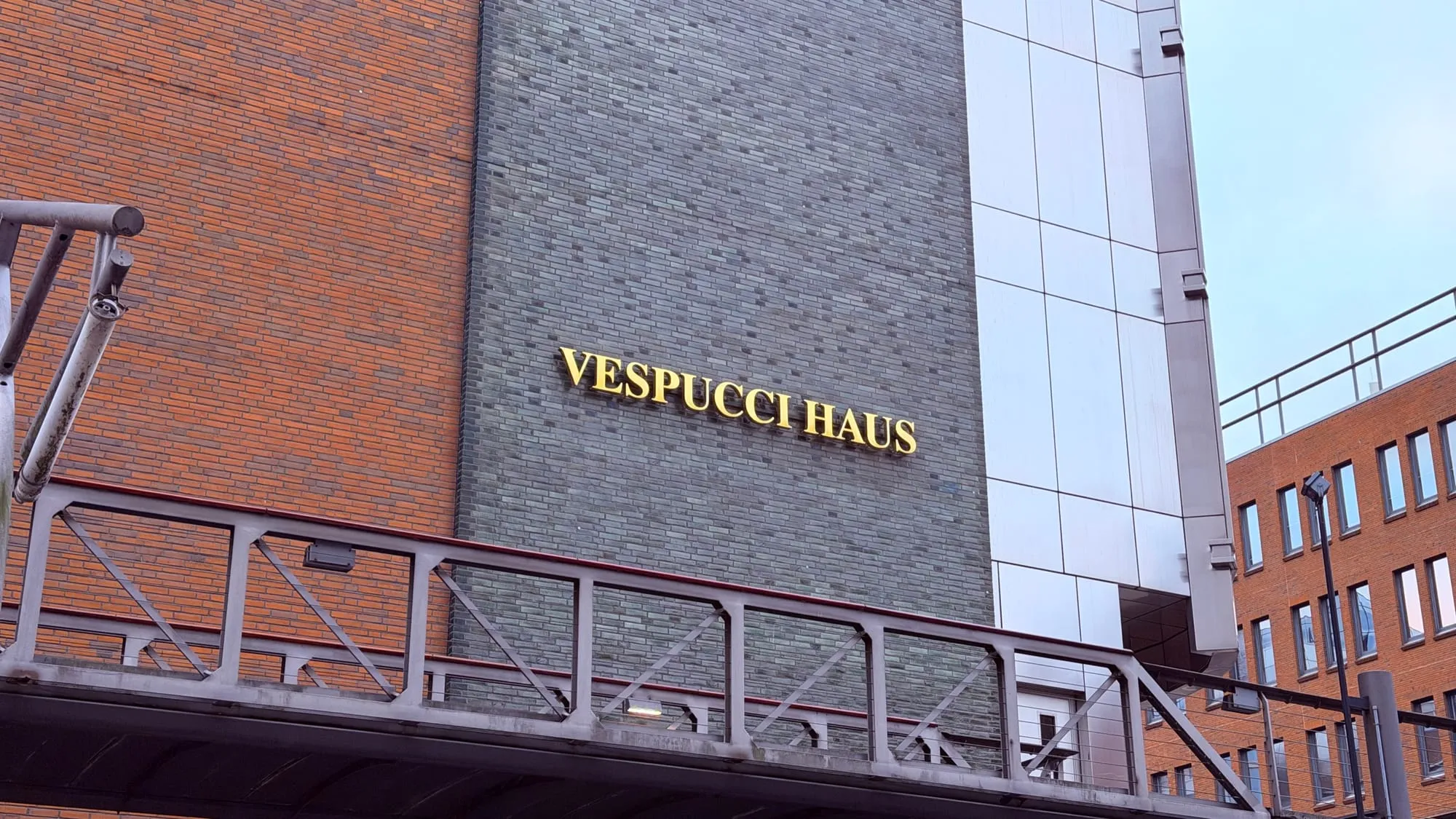
That rule brings us back to the explorers. Since at least 2010, critics have said that men like Vasco da Gama and Amerigo Vespucci also stand for conquest, slavery and colonial violence. When the Amerigo-Vespucci-Platz opened in 2021, a local postcolonial group asked the city to stop naming places after them. HafenCity Hamburg admitted that nobody had looked at the names this way when they were chosen, but said it could not change them on its own. So far, the names have stayed.
How a name is chosen
So how does a street actually get its name in Hamburg? Officially, the Senate names every street, square and bridge. In HafenCity, the proposals mostly come from HafenCity Hamburg, the district votes on them, and the State Archive checks them against a few simple rules: names should be short, have something to do with the place, and not be too similar to an existing one.
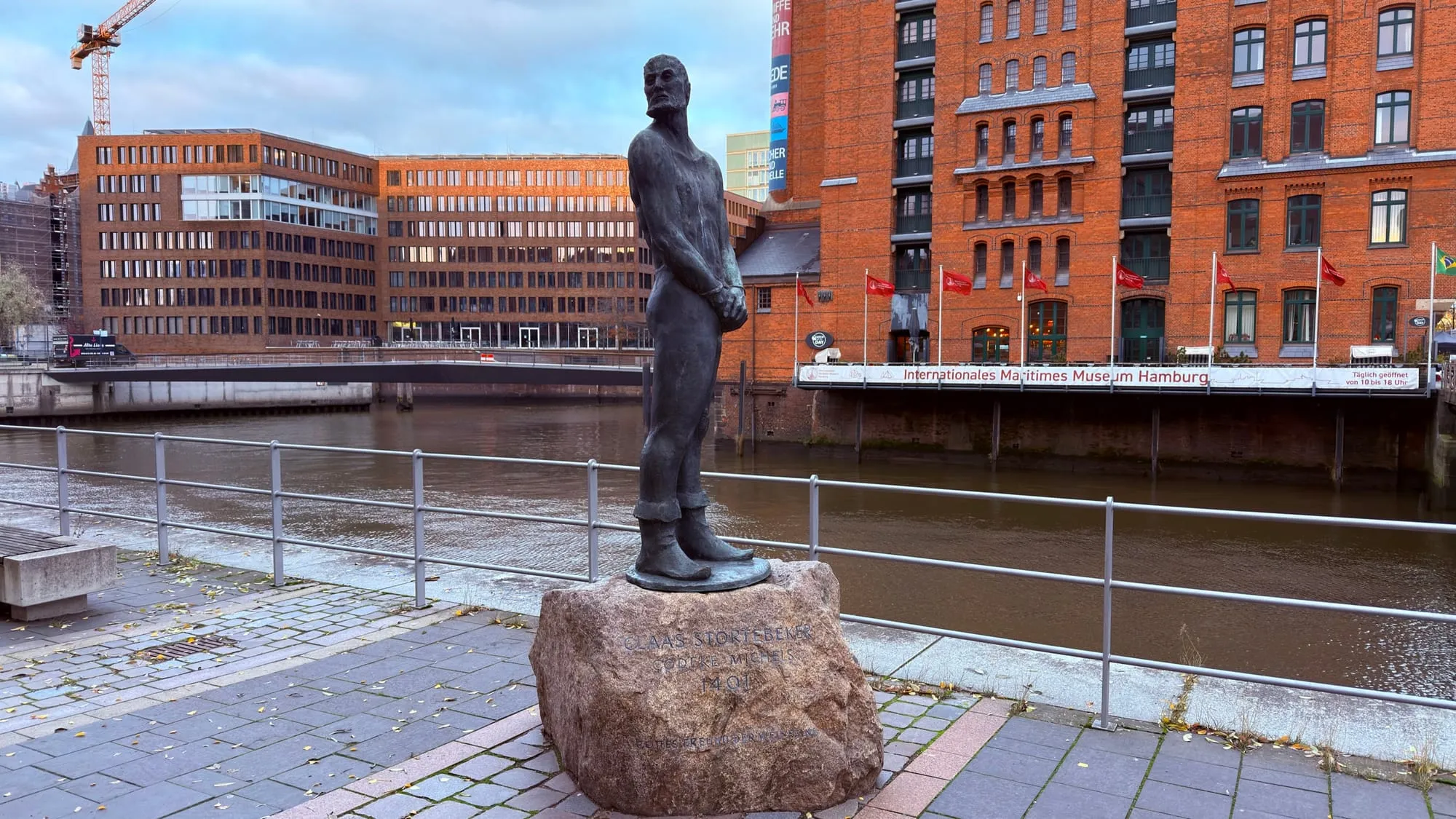
HafenCity is still getting new names today. The square in front of the Elbphilharmonie has been called Platz der Deutschen Einheit since 2012. The Störtebeker Ufer, from 2013, remembers the pirate Klaus Störtebeker, who according to legend was beheaded on the Grasbrook in 1401, so the city named a quay after one of its old enemies. In 2019, a square near the HafenCity University was named after Henning Voscherau, the mayor who first presented the idea of HafenCity in 1997. And in 2023, the promenade around the Spiegel building became the Rudolf-Augstein-Promenade, for the founder of Der Spiegel.
Naming anything, not just a street, is probably one of the hardest things to do. In a place like HafenCity, with so much history, both good and bad, it gets even trickier. Still, names like Miamiplatz or the Mahatma-Gandhi-Brücke make no sense to me, because neither the place nor the person has anything to do with Hamburg. I would have expected names that come from the trade itself rather than from people, since those tend to be less controversial. Think of the goods that came through this port, like different kinds of coffee, or the farms that grew them. An Arabicastraße or a Kakaokai would tell you much more about this place than a Miamiplatz. The Speicherstadt already does this in a small way, with names like Teerhof, after an old tar store. Without those goods and farms, Hamburg would not have had anything to trade, and it would never have become as rich as it is, even if those goods have a complicated history of their own.