Why Doesn't Hamburg Have a Public Project Board?
A public Kanban board could make Hamburg’s projects more transparent and strengthen democracy by showing citizens how public money is being spent.

Hamburg is building a new metro line, replacing major bridges, renovating schools and transforming parts of its energy infrastructure. Billions of euros are being invested in projects that will shape the city for decades. Yet there is no single place where residents can see what is planned, what is under construction, what has been completed and what is delayed.
The information often exists somewhere. It may be on the website of a public authority, in a press release from Deutsche Bahn or HOCHBAHN, in a parliamentary document, in a budget plan or inside a procurement portal. But the information is scattered across different websites and published in different formats. Following one project is difficult. Understanding the complete picture is almost impossible.
What if every major public project in Hamburg appeared on one simple board?
From factory floors to software teams
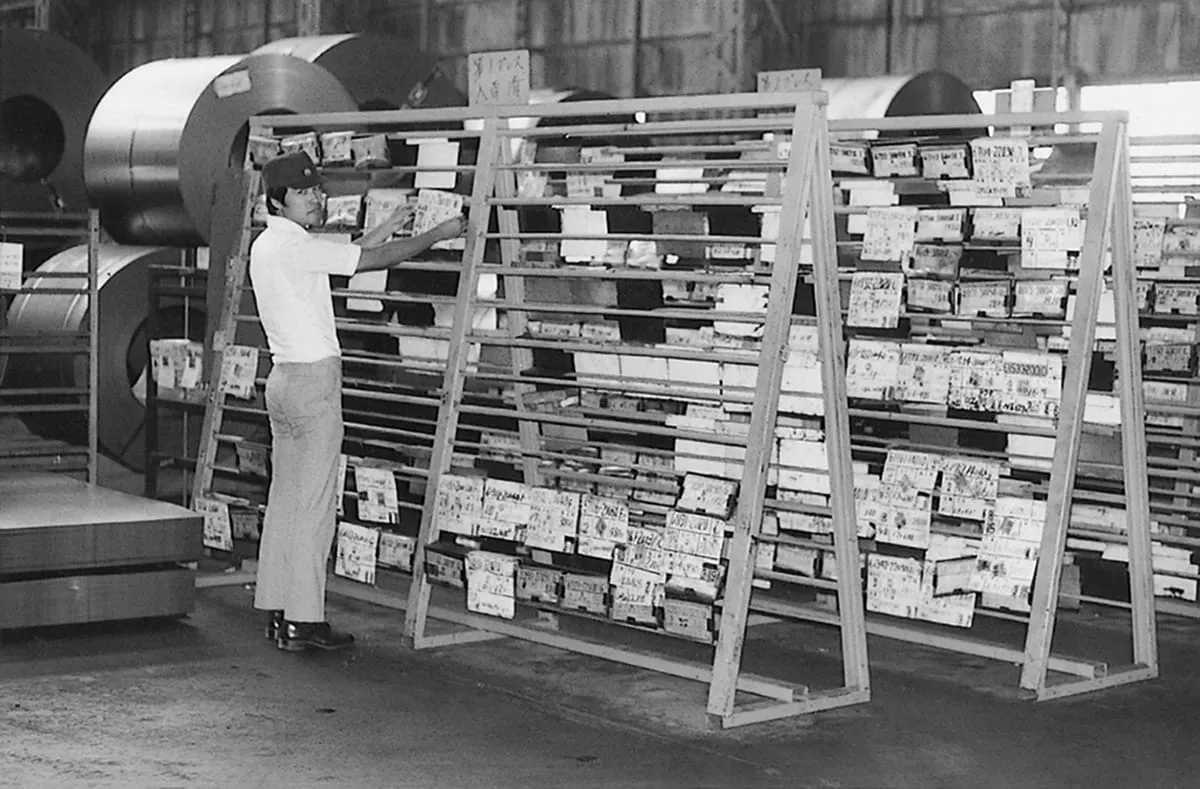
Kanban began on Toyota's factory floors in Japan in the late 1940s. The idea was partly inspired by supermarkets, where products were restocked after customers removed them from the shelves. Toyota introduced visual cards—called kanban—that signalled when a part was needed. A card moved with the work, making it easy to see what was waiting, what was in progress and where production had slowed down. Decades later, the same principle moved beyond factories and into offices and software teams around the world.
I first worked with Kanban at my first job, where our team was improving the onboarding flow at XING. Our designer and product owner planned what needed to be built, and we, the software developers, turned those ideas and designs into tasks. Each task generally had to be small enough to test and ship.
Once a task was assigned to someone, it started its journey across a board with columns such as Backlog, In Progress, In Review, In QA and Done. I could immediately see the tasks assigned to me, the work waiting to be picked up and everything we had completed. There was also something satisfying about moving a card into the Done column.
The board was not useful only for individual developers. It helped the product owner and engineering manager see bottlenecks. If cards started piling up in the Review column, for example, it often meant that developers were concentrating on their own tasks and not spending enough time reviewing the work of their colleagues. The board made a problem visible before someone needed to write a long report about it.
We used Jira, although the same kind of board can now be created with tools such as Trello, Notion, Linear or OpenProject. The particular software is not important. What matters is that everyone sees the same work, the same status and the same bottlenecks.
From software teams to public projects
When I think about the visibility that the Kanban board brought to our work, I start to wonder why we do not have something similar for public projects.
I do not mean that every public project needs its own public Kanban board. Government agencies probably already use Kanban or other project-management systems internally. I mean one public-facing overview, inspired by Kanban, where every major project is represented by one card. I call it a Public Project Board.
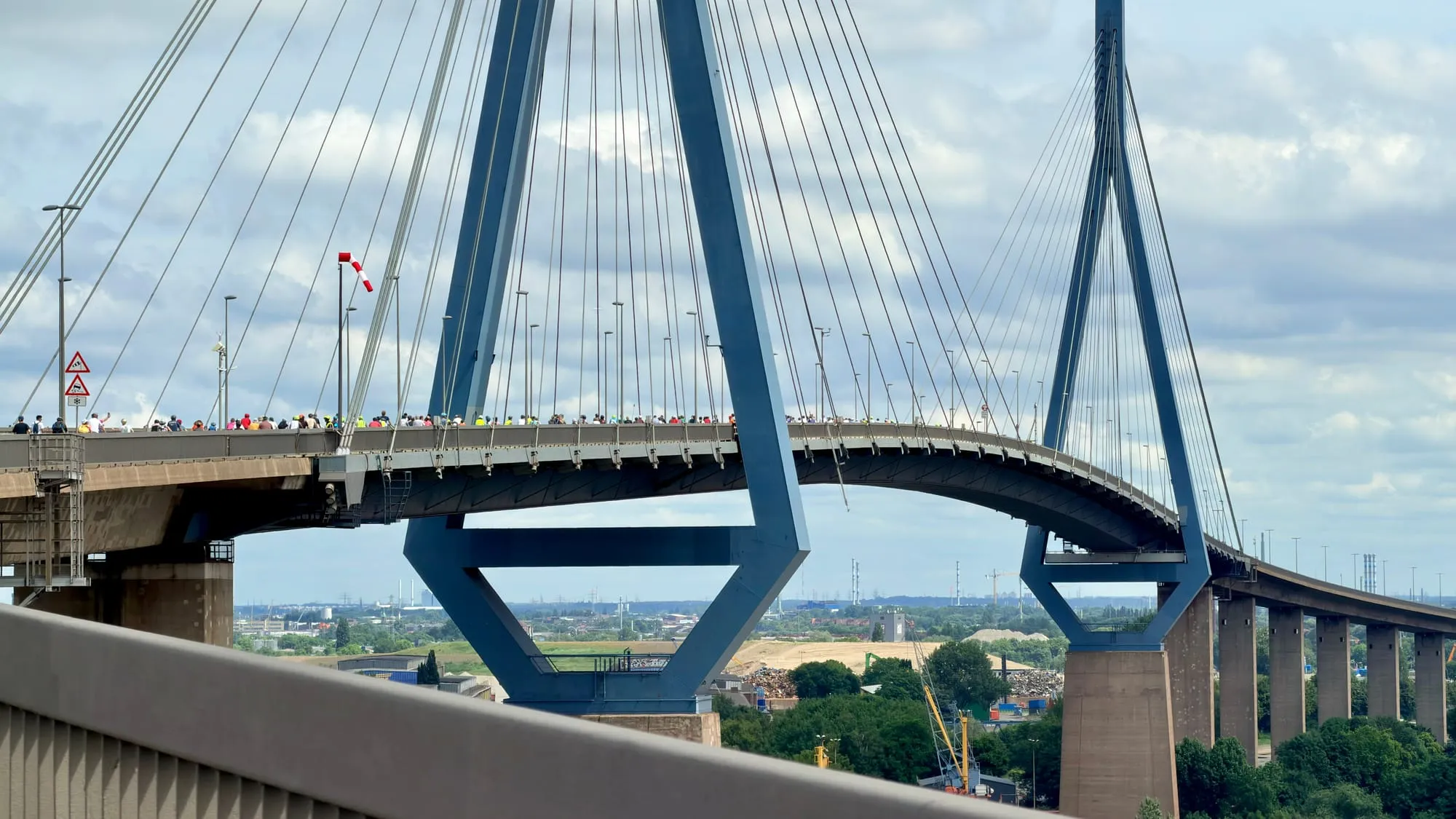
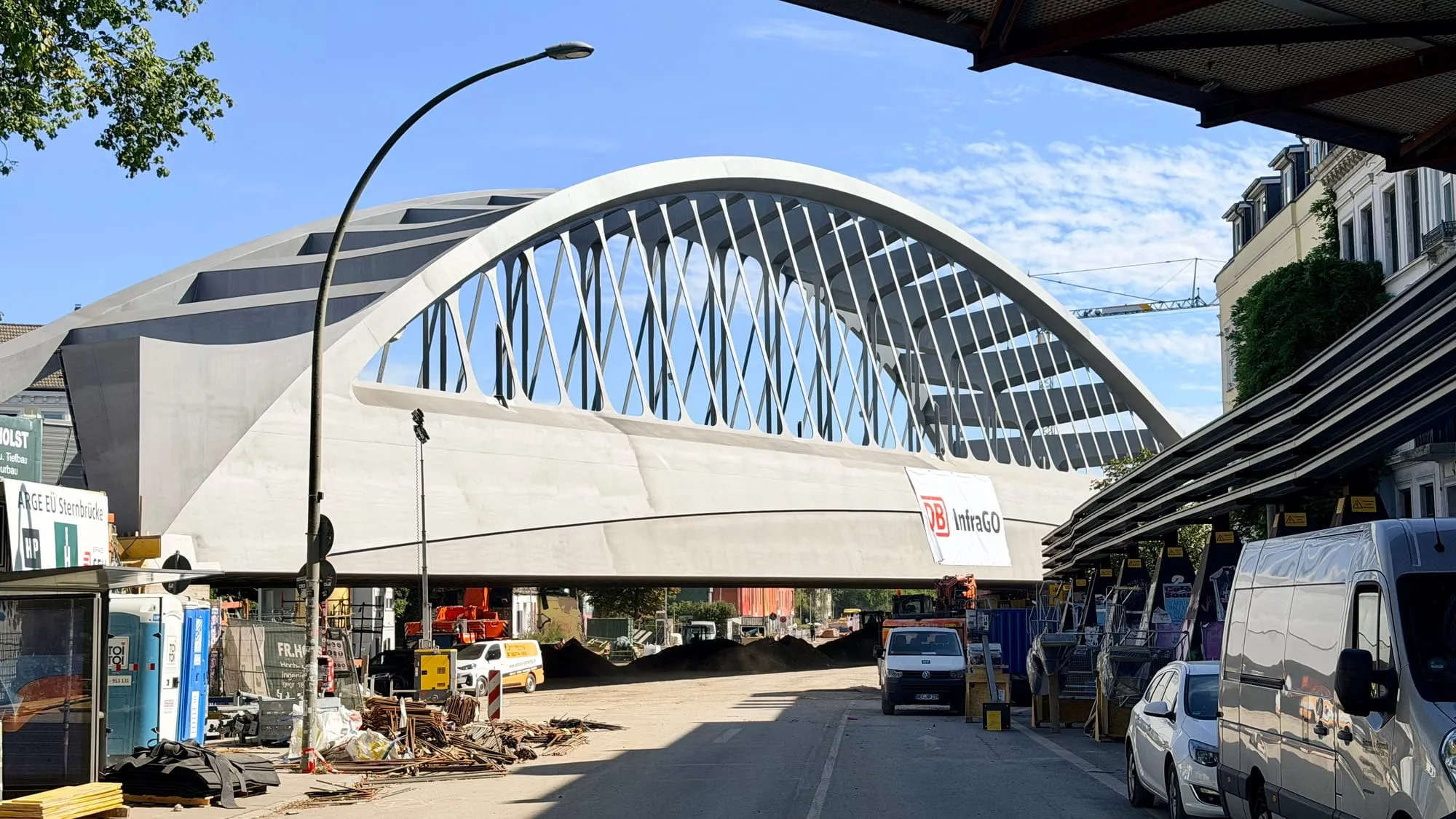
The replacement of the Sternbrücke, the construction of the U5 and the planned replacement of the Köhlbrandbrücke are only a few examples of large projects in Hamburg. We usually hear about them when they are announced, when construction begins, when something goes wrong or when a new political debate starts. If we miss that moment in the news, it can be surprisingly difficult to answer simple questions later: Is the project still planned? Has work started? Is it delayed? How much does it cost now? Who is responsible for it?
This creates a distorted picture of what the government is doing. The projects that receive the most media attention are not necessarily the only projects under way, or even the most expensive ones. A person may see a problem in the city and assume that nothing is being done about it, while several relevant projects are already planned or in progress. At the same time, an announced project may quietly fall behind schedule without the public having a simple way to notice.
A Public Project Board would not solve those problems by itself, but it would give everyone the same starting point.
My proposal
Hamburg should have one central Public Project Board for major public projects. Each project would be represented by a card and placed in a clear status column, such as Planned, In Progress, Completed or Delayed. Later versions could add stages such as Under Review, Approved, Procurement and Cancelled, but the first version does not need to be complicated.
To keep the board manageable, it could initially include projects with a total expected cost of at least €10 million. Projects below that limit could still be included when they are strategically important or have a major effect on the public. The threshold should apply to the total project cost—not just one contract or one year of spending—so a large project cannot disappear from view simply because it has been divided into smaller contracts.
At a glance, each card should answer a few basic questions:
- What is being built or changed?
- What is its current status?
- When did it begin, and when is it expected to finish?
- What were the original budget and deadline, and what are they now?
- Which authority is accountable, and which organisations are delivering the work?
- When was the information last updated?
- If the project is delayed or over budget, why?
The detailed view could contain the location, milestones, funding sources, previous updates and links to the relevant decisions, contracts and official documents. Most importantly, old information should not simply be overwritten. A visible change history would allow people to see when a deadline or budget changed and read a short explanation.
Public authorities already publish updates for many projects. A central board would give those updates a common home and a common format. Each responsible authority should update its cards at least once every three months and whenever a project's status, budget or expected completion date changes. In many cases, one or two sentences about the latest milestone would be enough. Each card should display its last update clearly; stale information should be visible rather than quietly looking current.
What the prototype showed me
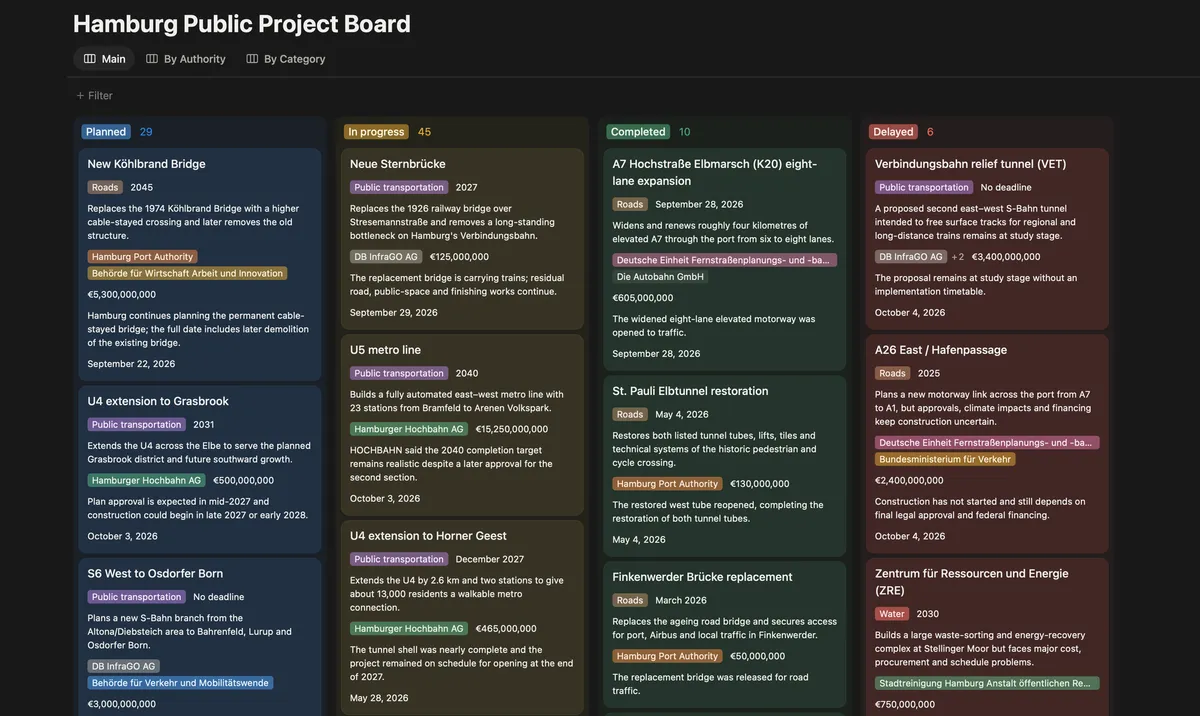
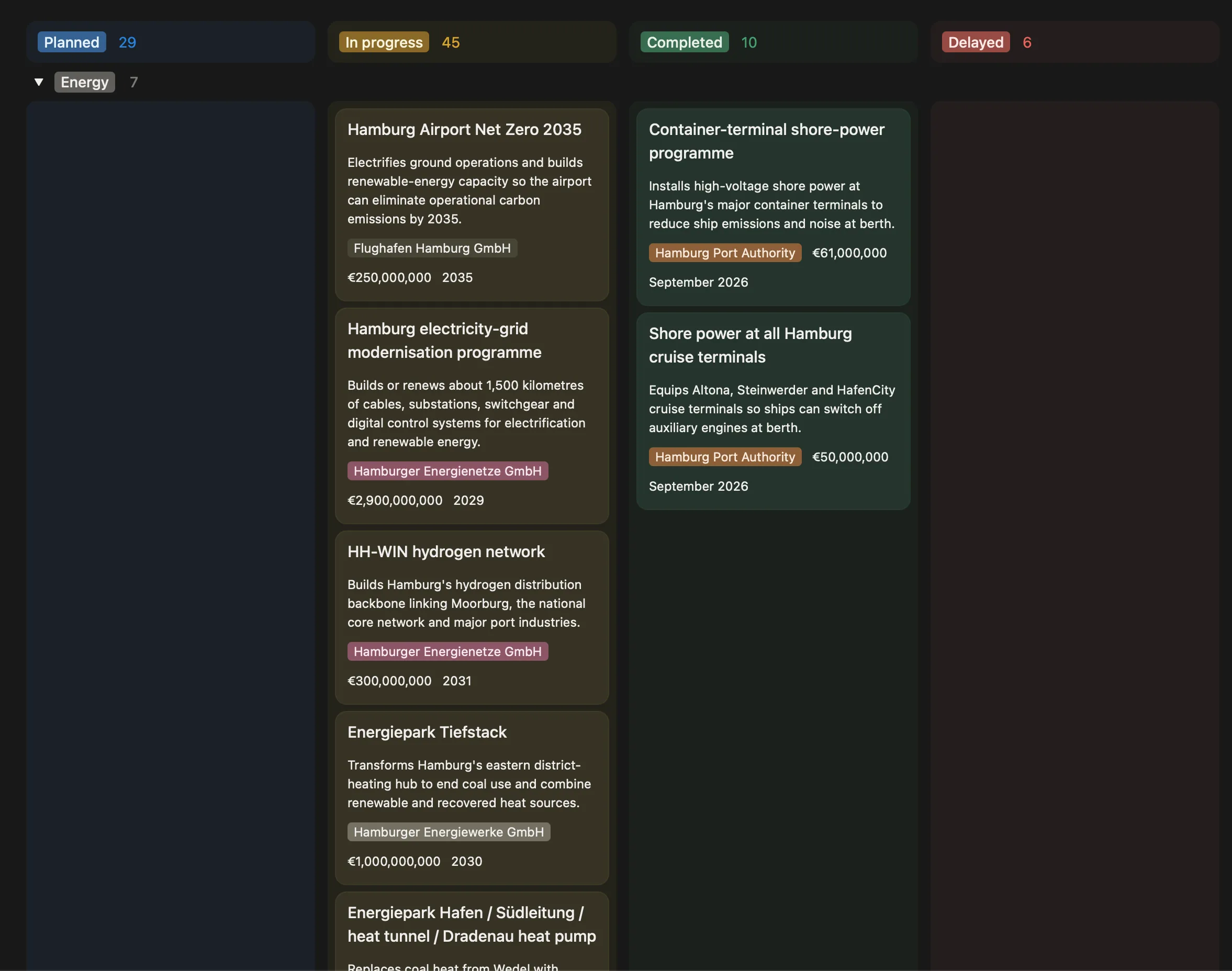
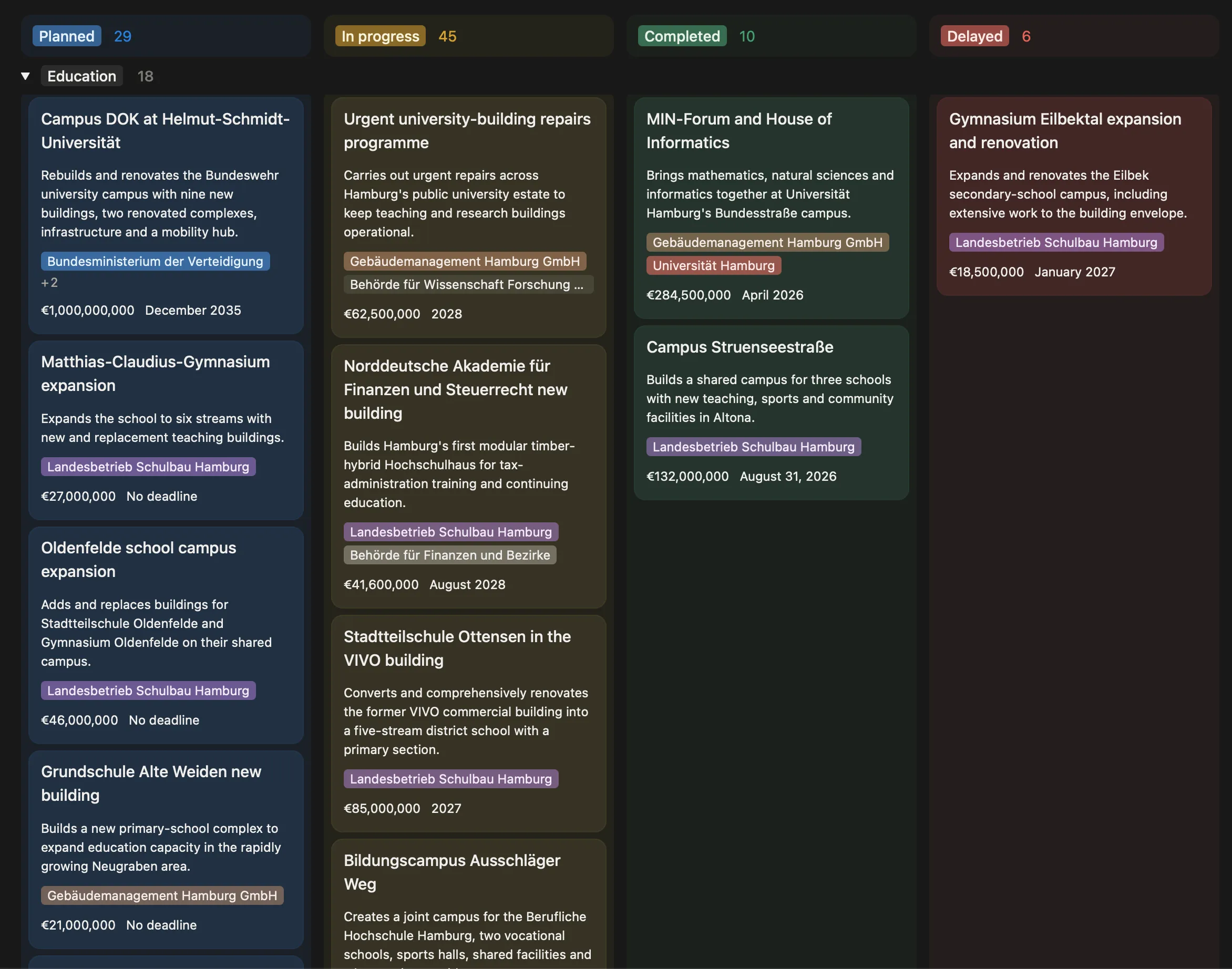
To visualise the idea, I created a simple Hamburg Public Project Board in Notion. I used four columns—Planned, In Progress, Completed and Delayed—and added categories such as roads, public transportation, education, culture, energy and water. The projects can also be viewed by category or responsible authority.
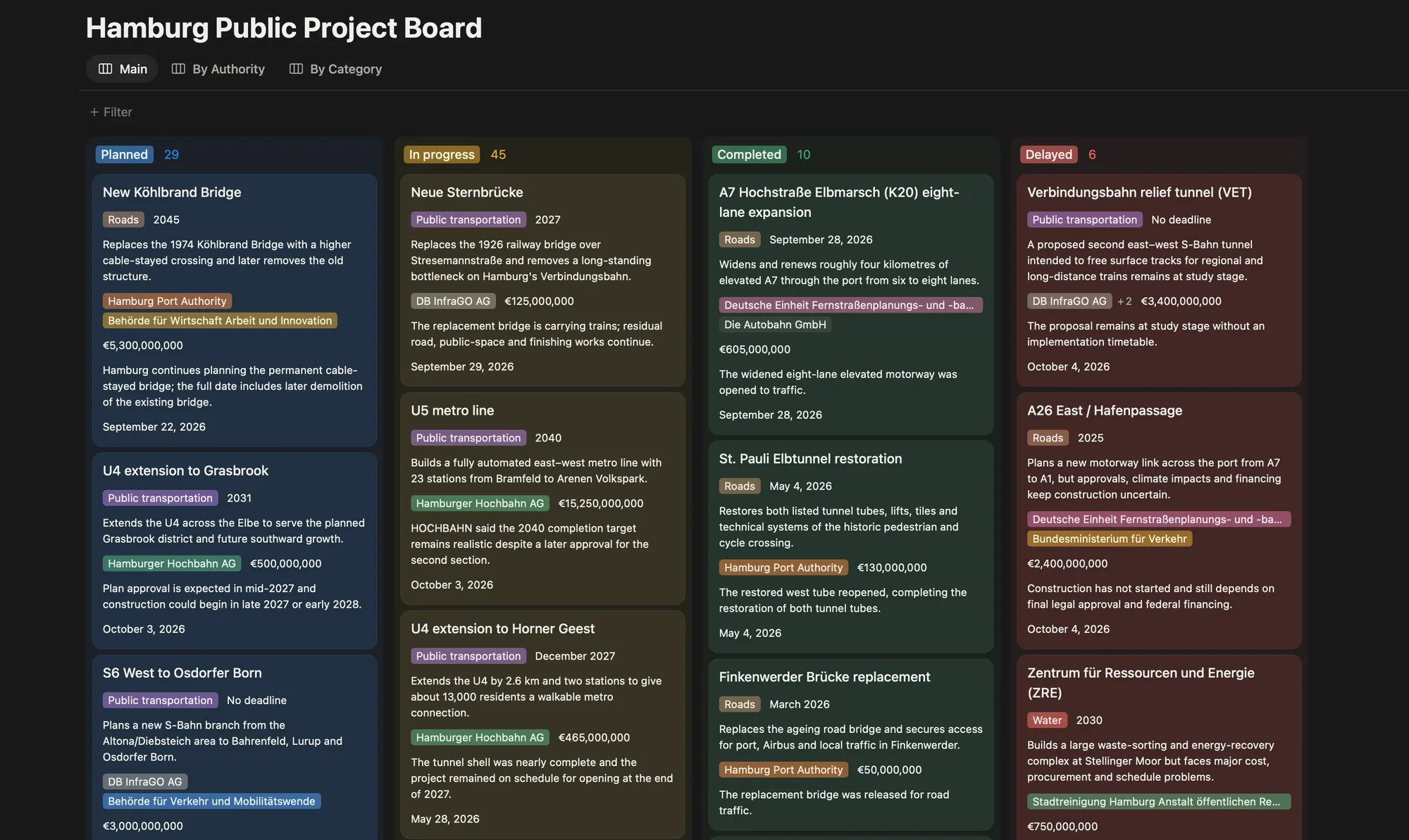
I built the prototype by collecting information from project pages, public-authority websites, press releases and other publicly available sources. I generally included projects with an expected total cost of at least €10 million, although projects below that threshold could still belong on an official board when they have exceptional public importance. Because the information is fragmented and continues to change, my dataset should be understood as an experiment rather than an official or complete record.
The prototype contains around 90 projects across 15 categories, generally with an estimated cost of at least €10 million. At the time of writing, 29 are planned, 45 are in progress, 10 are completed and 6 are delayed. In other words, more than half of the projects on the board are either in progress or delayed, while almost one-third are still in the planning stage. Even this basic distribution gives a clearer picture of how much work is moving through the city at the same time.
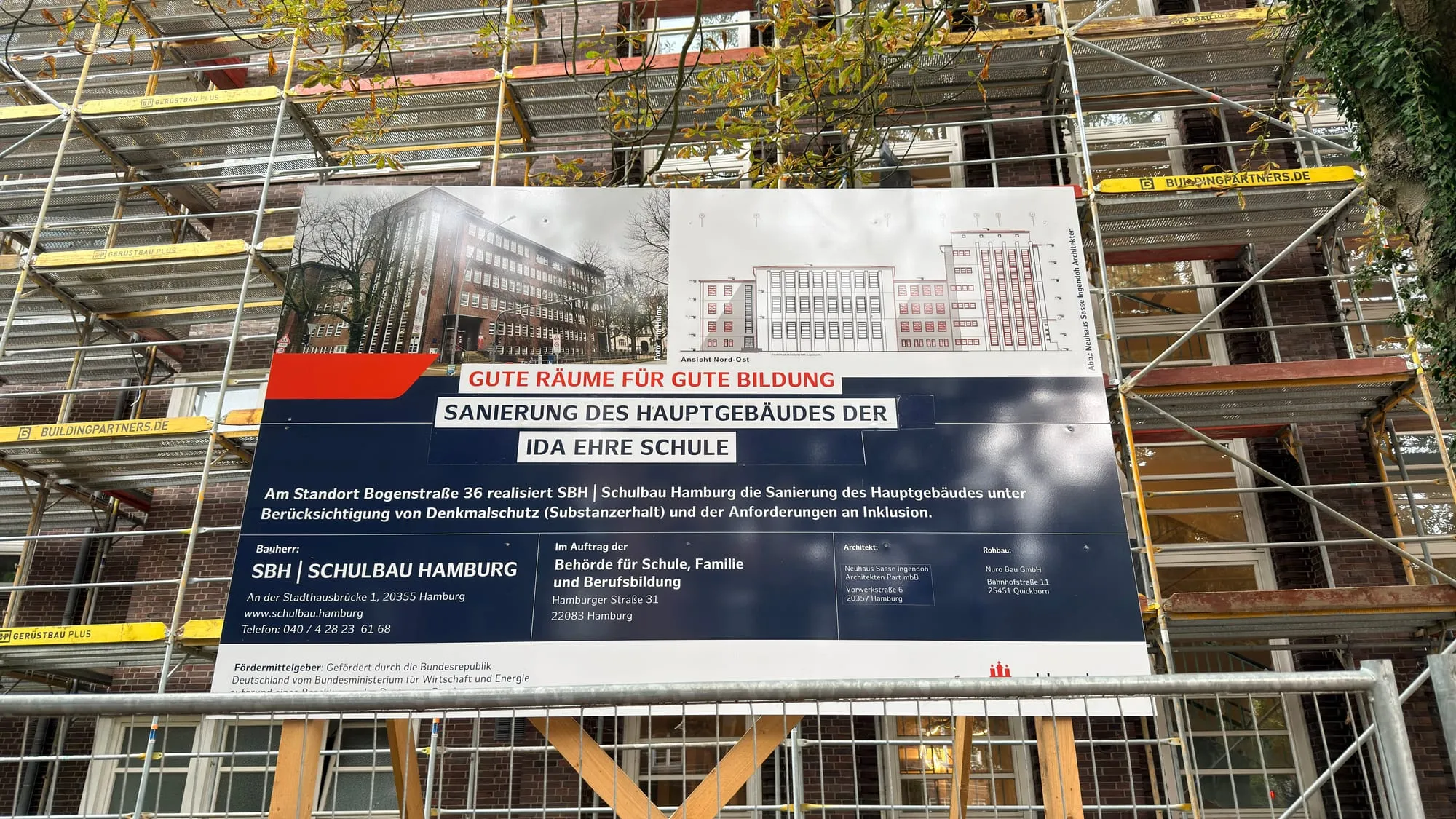
I was particularly surprised by education. I found around 18 projects in that category. When I cycle through Hamburg, I regularly pass schools being renovated or expanded, but I had not realised how large the combined programme was until I saw the projects together on one board.
Looking at the estimated budgets by category produced another striking picture. The three largest categories in my dataset were:
- Public transportation: ~€34.124 billion
- Roads: ~€12.669 billion
- Education: ~€12.282 billion
These figures should be read as an illustration, not as an audited statement of Hamburg's budget. Some projects involve federal institutions, public companies or neighbouring regions, and broad programmes may overlap with individual projects. The list is incomplete, and some figures or statuses may contain errors. But that limitation is itself part of the argument: compiling a reliable overview should not depend on one person searching through dozens of websites.
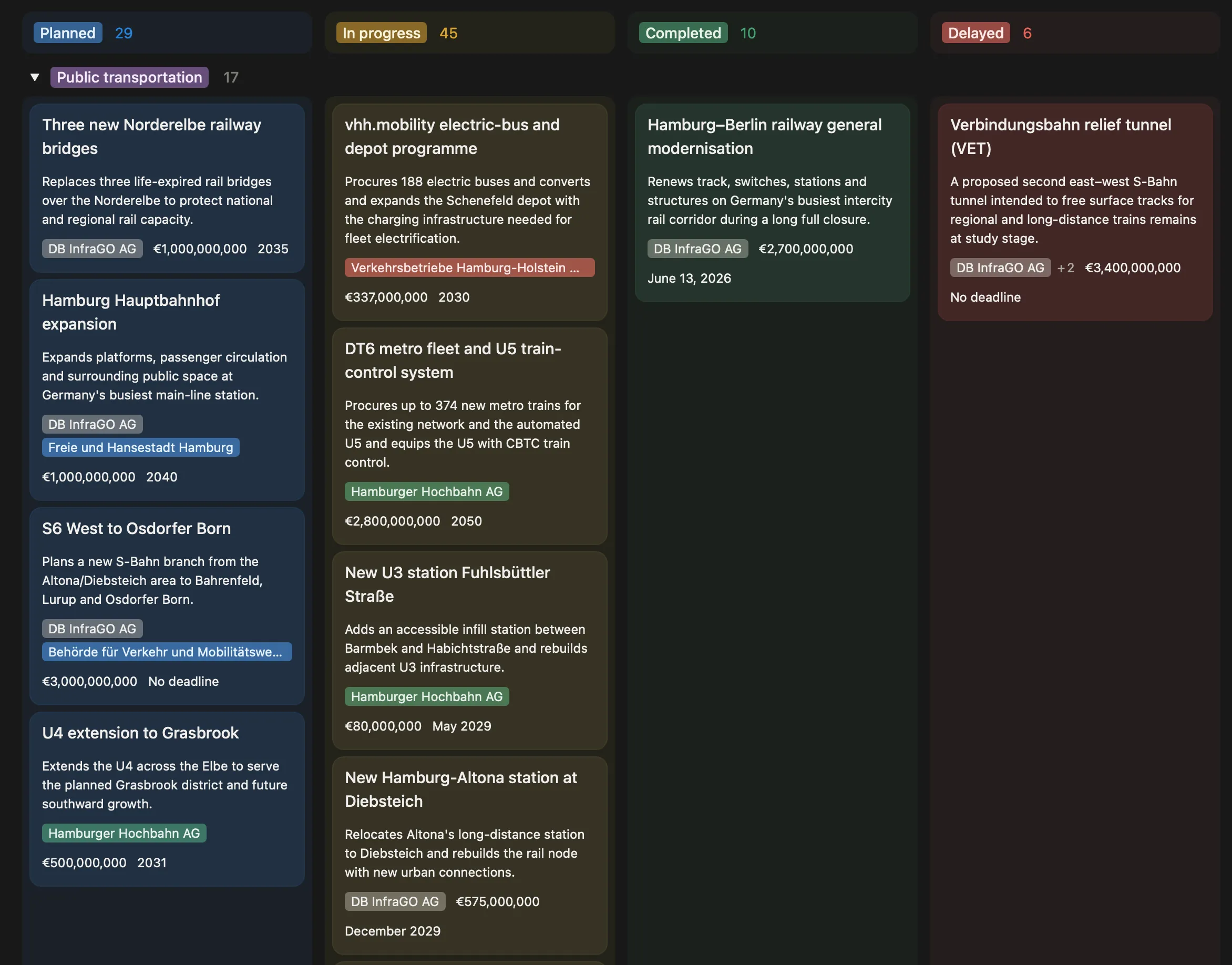
The board also changed my impression of what counts as a public project. Transport and bridges are very visible, but the city is also investing in flood protection, wastewater treatment, energy networks, hospitals, research buildings, schools, museums and cultural venues. Seeing those projects side by side makes the scale and variety of public work much easier to understand.
Transparency is more than publishing documents
Governments often describe information as public because a document can technically be found online. But transparency is not only about making information available. It is also about making it understandable, comparable and easy to follow over time.
A Public Project Board would allow residents to follow the areas that matter to them. A regular public-transport user could filter for rail and metro projects. A parent could see which schools are being built or renovated. Someone living near the port could follow road, bridge, energy and environmental projects in that area. Journalists, researchers and elected representatives could compare delays, budget changes and patterns across authorities instead of investigating each project from zero.
It could also improve communication inside government. Authorities would have a shared format for reporting progress, and public servants would spend less time answering the same basic questions in different places. A stable project ID and an open-data interface would allow media organisations and civic developers to build maps, notifications and other tools on top of the same information.
This matters for democracy because public debate becomes better when people can start from a shared set of facts. Citizens can ask why one district receives more investment than another, why a deadline changed, or why one type of project repeatedly becomes delayed. They can compare political promises with actual delivery. They can also see work that is progressing quietly and rarely appears in the news.
Of course, a colourful board does not automatically create trust. If authorities update only successful projects, hide budget increases or leave delayed cards untouched for months, the board becomes another public-relations tool. For it to be credible, the good and bad news must be equally visible. Every card needs a responsible authority, a last-updated date, links to source documents and a history that cannot be silently rewritten.
That kind of transparency would not stop disagreement about taxes or public spending—and it should not. Democracy depends on disagreement. But it would allow those arguments to be based on clearer information: what is being funded, what has been delivered, what has changed and who is accountable.
My board is only a prototype, and it is neither complete nor official. Still, after looking at it for a few minutes, I could see more clearly how much is happening across Hamburg and how many projects are planned for the coming years. An official version, maintained by the authorities responsible for the work, could provide something far more valuable: a simple, shared view of how public money is being turned into public infrastructure and services.
Public projects are already public. Their progress should be public too.