Hamburg said NO to the Olympics, and the map tells a story
Hamburg said NO to the Olympics, but a look at the map reveals a striking pattern: the richer the district, the more it voted YES.

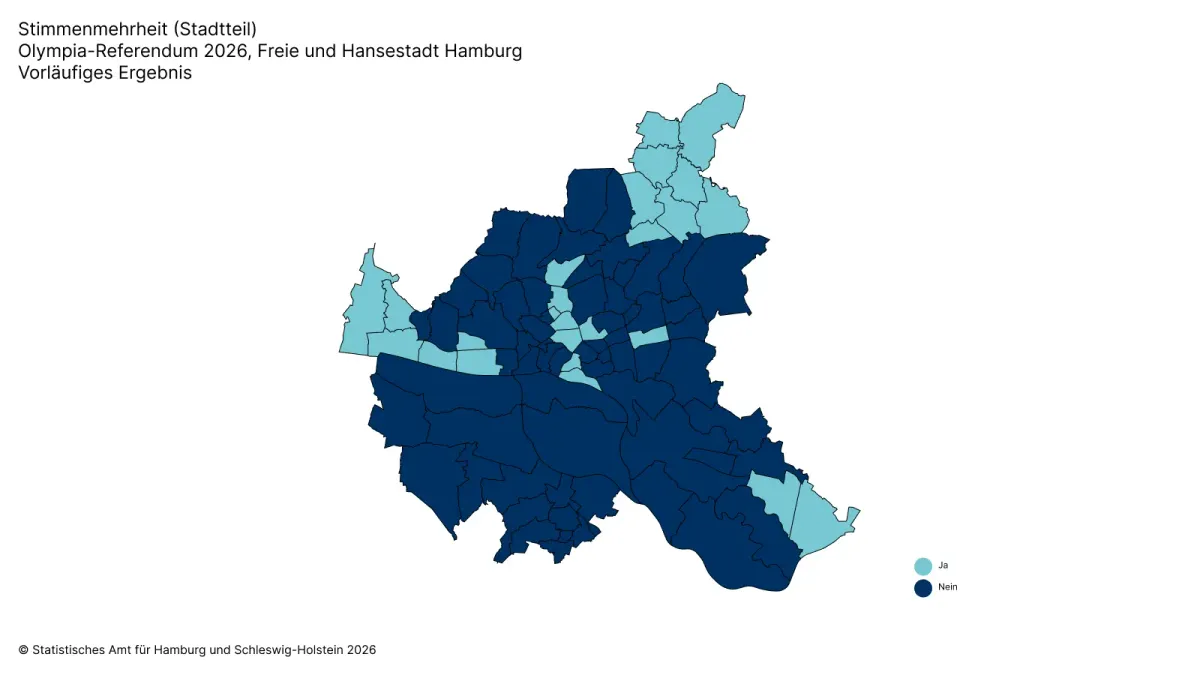
On Sunday, Hamburg made its choice and said NO to bidding for the Olympic Games. According to Statistik Nord, turnout was 49.6%, and of those who voted, 54.9% said NO while 45.1% said YES.
What caught my attention wasn't the headline result. It was the handful of districts that voted YES.
Looking at the map, I had a hunch before I'd read a single number: the districts shaded for "YES" seemed to line up with the parts of town known for being wealthy. Rather than jump to conclusions, I wanted to actually check whether there was a relationship between voting YES and a district's median income.
The result didn't surprise me.
Across Hamburg's roughly 90 districts, there's a strong link between how wealthy an area is and how strongly it voted YES: the richer the district, the higher the YES share, and the pattern is remarkably consistent. The wealthiest districts (Blankenese, Nienstedten, HafenCity) backed the bid, while the poorest (Veddel, Wilhelmsburg, St. Pauli) rejected it heavily. Statistically, the link is strong: the correlation between a district's median income and its YES share is r = 0.81 (Spearman rank correlation 0.80), which means income alone explains roughly two-thirds of the variation in how districts voted. That is a very tight relationship for this kind of data. (The income figures are the 2021 median income per district from Statistik Nord's income tax statistics.)
A caveat worth stating plainly: this shows that richer districts voted YES, not necessarily that richer individuals did. Wealth also travels with other things like age, education, and home ownership, any of which could be part of the story. But the signal is hard to ignore.
Now, the numbers can't tell us why people voted the way they did. A YES voter in Blankenese and a NO voter on the Veddel might both have had the city's best interests at heart, just with very different ideas of what that looks like. So everything from here is interpretation, not data. But the pattern is striking enough that it's worth sitting with.
It reminded me of a book I read recently, The Tyranny of Merit: What's Become of the Common Good? by Michael Sandel. In it, Sandel argues that the populist revolt, meaning Trump, Brexit, and movements like them, was driven in large part by the resentment of working people who felt looked down upon by credentialed elites.
I think a version of that logic is worth watching in Germany, where the vote of the AfD's vote share is climbing. It's easy for mainstream parties, here the SPD and the Greens, to rally behind a big, prestigious project and assume the whole city shares the enthusiasm. A referendum is a blunt way of finding out who actually does. And on this one, the parts of town with the least money were the parts that most clearly said NO.
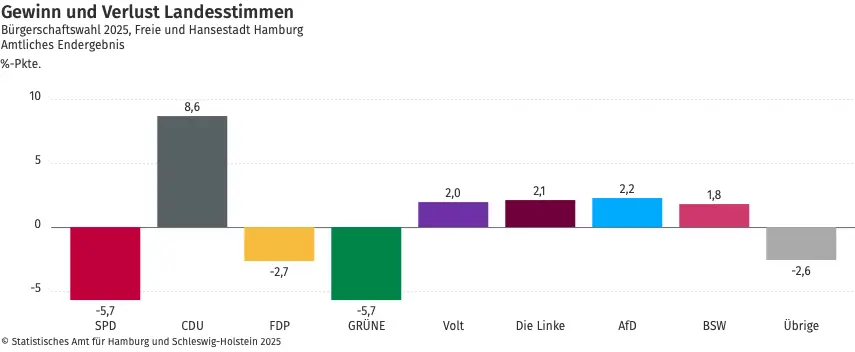
I don't think that's a coincidence, and I don't think it's only about the Olympics. The last Hamburg state election, in March 2025, saw both the SPD and the Greens lose roughly 5,7 points each compared to the previous vote. That wasn't long ago. A result like Sunday's reads, to me, like the same signal arriving again: a gap between what the governing parties want to champion and what a large share of the city is asking for.
I'd love to see that gap taken seriously. Not because the Olympics were uniquely bad, but because the map is a reminder of who tends to get left out when a city chases its grand projects. The more Hamburg closes that distance, in income and in attention, the better a place it becomes to live for all of us, not just some of us.