
Why is direct democracy still signed on paper?
Hamburg has a strong system for direct democracy, but popular initiatives and popular petitions still rely on paper signatures. Is it time to allow digital signing?


A couple of years ago, I was taking a walk in Stadtpark when I saw a group of people holding clipboards and pens. They were talking to people who were sitting or walking around the park. Later, I learned that they were collecting signatures for a popular initiative (Volksinitiative).
At that time, I did not know much about what a popular initiative was. At first, it sounded to me like a campaign on Change.org. But when I looked into it more, I realized that it is probably one of the most powerful parts of democracy. It allows people to take part in direct democracy, but the process is more complex than it first seems.
In Hamburg, popular legislation (Volksgesetzgebung) was introduced in 1996. It allows eligible citizens to change laws, repeal existing laws, or propose new draft laws. The process has three steps: the popular initiative, the popular petition, and the referendum.
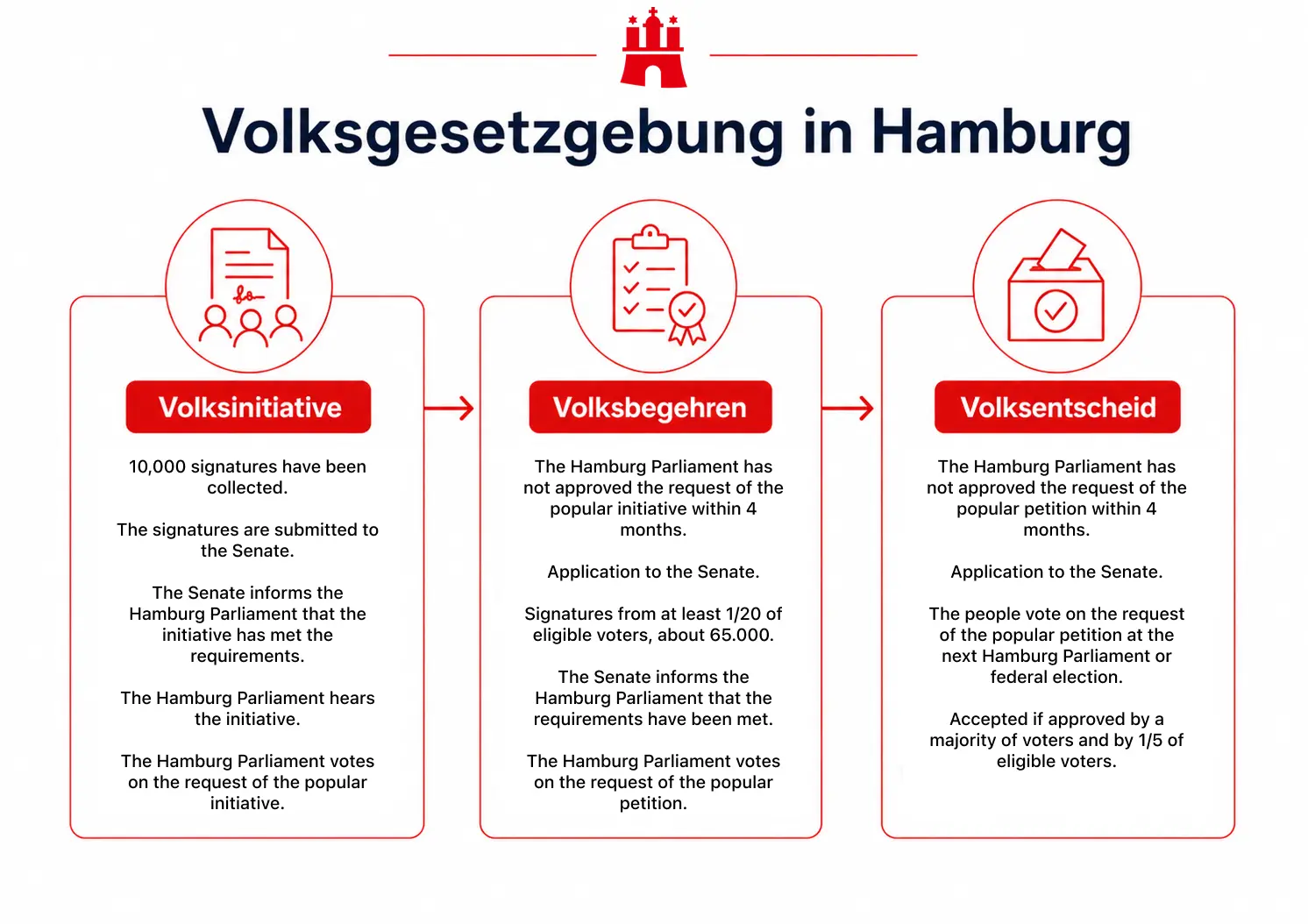
The first step is the popular initiative. This is where people collect signatures for a proposal on a certain topic. They need to collect 10.000 signatures. If they manage to do that, they submit the signatures to the Hamburg Senate. The Senate checks whether the requirements have been met and informs the Hamburg Parliament. The Parliament then has four months to decide whether it wants to act on the proposal.
If the Parliament decides not to act, meaning it does not adopt the proposed change, the second step begins. This is the popular petition. At this stage, the number of signatures depends on the number of eligible voters. If 1 out of 20 eligible voters sign the petition, which is around 65.000 people in Hamburg, then the signatures are submitted to the Senate again.
If the Parliament still does not adopt the proposed change within four months, the third and final step starts: the referendum. If the referendum passes, the result is legally binding on both the Hamburg Parliament and the Senate, and the responsible institutions must put it into effect.
Since 1996, there have been 68 proposals. Nine of them reached the referendum stage, and six of those were successful. Another 17 proposals were successful because an agreement was made with the state before reaching the referendum. Eight proposals were ruled inadmissible by the Hamburg Constitutional Court.
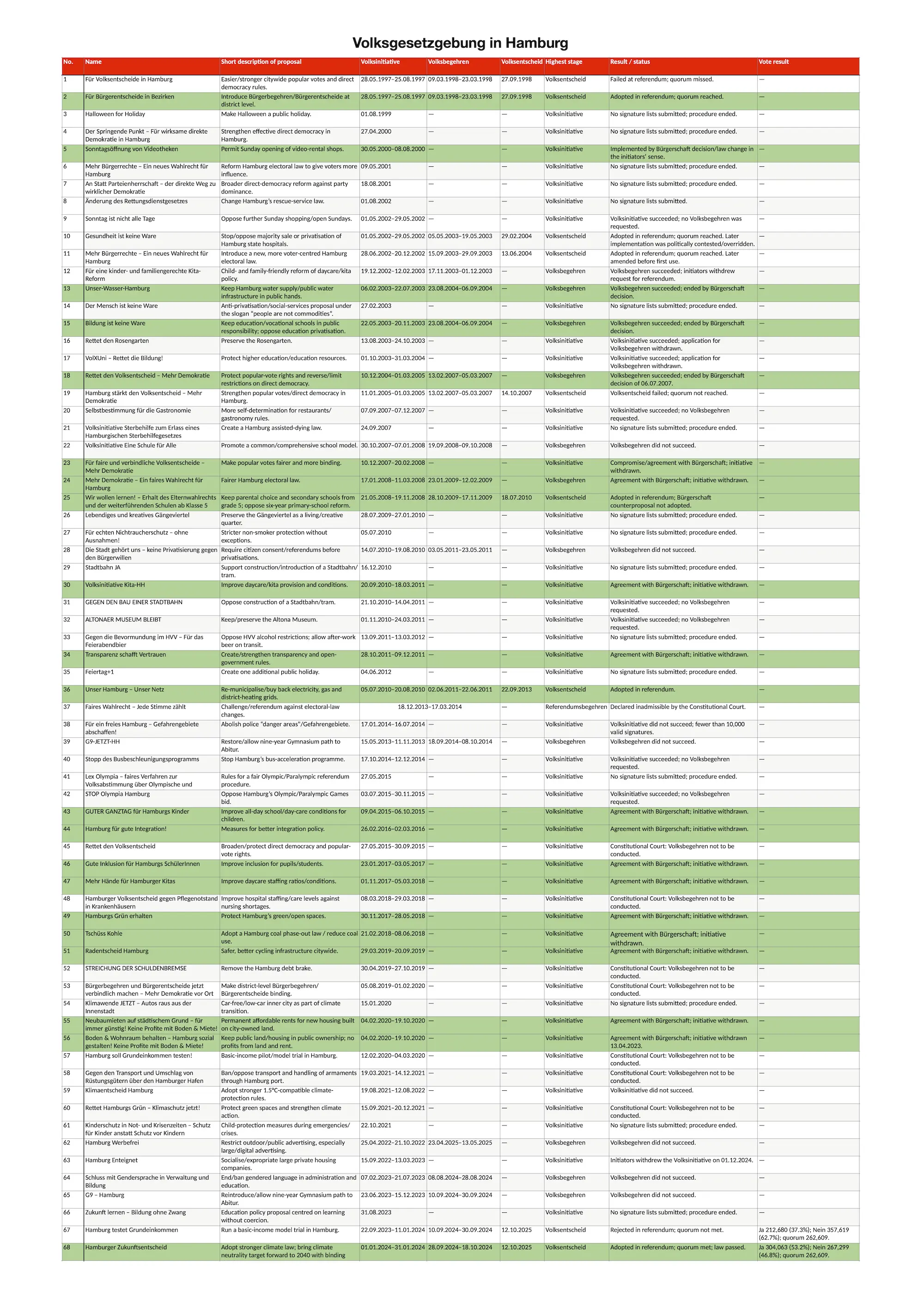
This is what I find interesting about popular legislation: it shows that there is real interest from citizens. Since the law was introduced, there have been almost two proposals per year. If we exclude the proposals that were ruled unconstitutional or inadmissible, the success rate is around 40%.
I also think popular legislation is becoming more important today, because the opinions of elected officials can be quite different from the opinions of citizens. The last two referendums in Hamburg are good examples of this.
The referendum about the Olympics was supported by the SPD, the Greens, and the CDU. Together, these parties received 71.8% of the votes in the 2025 election. But the referendum result was very different: 54.9% of voters voted against the Olympics. This shows that people do not blindly follow the positions of the parties they voted for. Of course, we should also remember that turnout in an election and turnout in a referendum are not the same.
A similar thing happened with the Hamburger Zukunftsentscheid referendum last year. The proposal did not get support from the parties forming Hamburg’s government, but in the referendum, people voted for the proposal to be implemented. This result also started a discussion about the transparency of campaign funding for these proposals. The current government is now planning changes around this topic.
These examples show that the opinions of citizens can be very different from the opinions of the parliamentary majority and the parties forming the government. That is why I believe popular legislation is becoming more and more important.
But there is one big problem with the system: logistics.
Apart from the paperwork needed to register a proposal, people still need to collect 10.000 signatures for a popular initiative. If the proposal moves to the second stage, they need to collect around 65.000 signatures for the popular petition, and they have only 21 days to do it. That means around 3.000 signatures per day.
This made me wonder: why don’t we allow people to sign popular initiatives and popular petitions digitally?
Digital signing would make it easier to propose laws. It would also make it easier for people to take part in lawmaking and democracy.
So I started by checking whether any German state already allows digital signing. I found out that our neighbour, Schleswig-Holstein, does.
It is possible to enable electronic signing of the popular initiative, either exclusively or in addition to collecting personal handwritten signatures on signature sheets (§ 6a VAbstG and § 2a VAbstGDVO — State Ordinance on the Implementation of the Referendum Act).
If I understand it correctly, this only applies to the first step, the popular initiative. For the second step, the popular petition, people still need to sign in person instead of digitally.
After seeing this, I wanted to know whether there is anything that would prevent Hamburg from allowing digital signatures for popular initiatives or popular petitions. So I started looking into the law and found this:
The popular petition is supported by personal handwritten signature in registration lists at the registration offices or through free collection by the initiators. Entries may also be made by other procedures that comply with the requirements of legally binding authentication and written form on the basis of existing federal and state law provisions.
Hamburg Act on Popular Initiatives, Popular Petitions and Referendums
(Referendum Act — § 9 VAbstG)
To me, this means that if a procedure complies with the rules for legally binding authentication and written form, then there seems to be a path to support popular petitions digitally.
That led me to look at the laws around electronic ID and the AusweisApp. I found this in the Federal Administrative Procedure Act:
The written form may also be replaced by directly submitting the declaration in an electronic form provided by the authority on an input device or via publicly accessible networks. In the case of submission via publicly accessible networks, electronic proof of identity under § 18 of the Personalausweisgesetz must be used.
Federal Administrative Procedure Act
(Administrative Procedure Act — § 3a(3) No. 1 VwVfG)
The mentioned Personalausweisgesetz also says:
The holder of an identity card who is at least 16 years old may use electronic proof of identity to prove their identity electronically to public and non-public bodies.
Act on Identity Cards and Electronic Identification
(Personalausweisgesetz — § 18(1) PAuswG)
I did not study law, so I might be missing something. But from what I understand, there seems to be a path for signing popular petitions digitally through the AusweisApp. Since Schleswig-Holstein is already using digital signing for popular initiatives, the method also seems valid in practice, even though each state has its own rules for popular legislation.
In the end, it looks to me like this is mostly a political decision. Hamburg already has a system for popular legislation, and electronic identification already exists. What is missing is the political will to connect the two.
Since Hamburg is already discussing changes to the rules around popular legislation, this would be the right time to include digital signing. Paper signatures should still remain possible, but citizens should also be able to support popular initiatives and popular petitions digitally.
Direct democracy should not depend on how many clipboards a campaign can carry through the city in 21 days. If the Hamburg’s political institutions truly wants to strengthen democracy, it should make participation easier without lowering the legal standards.
And if the Hamburg’s political institutions don't do it, maybe the next popular initiative should be about exactly that.